Direct answer
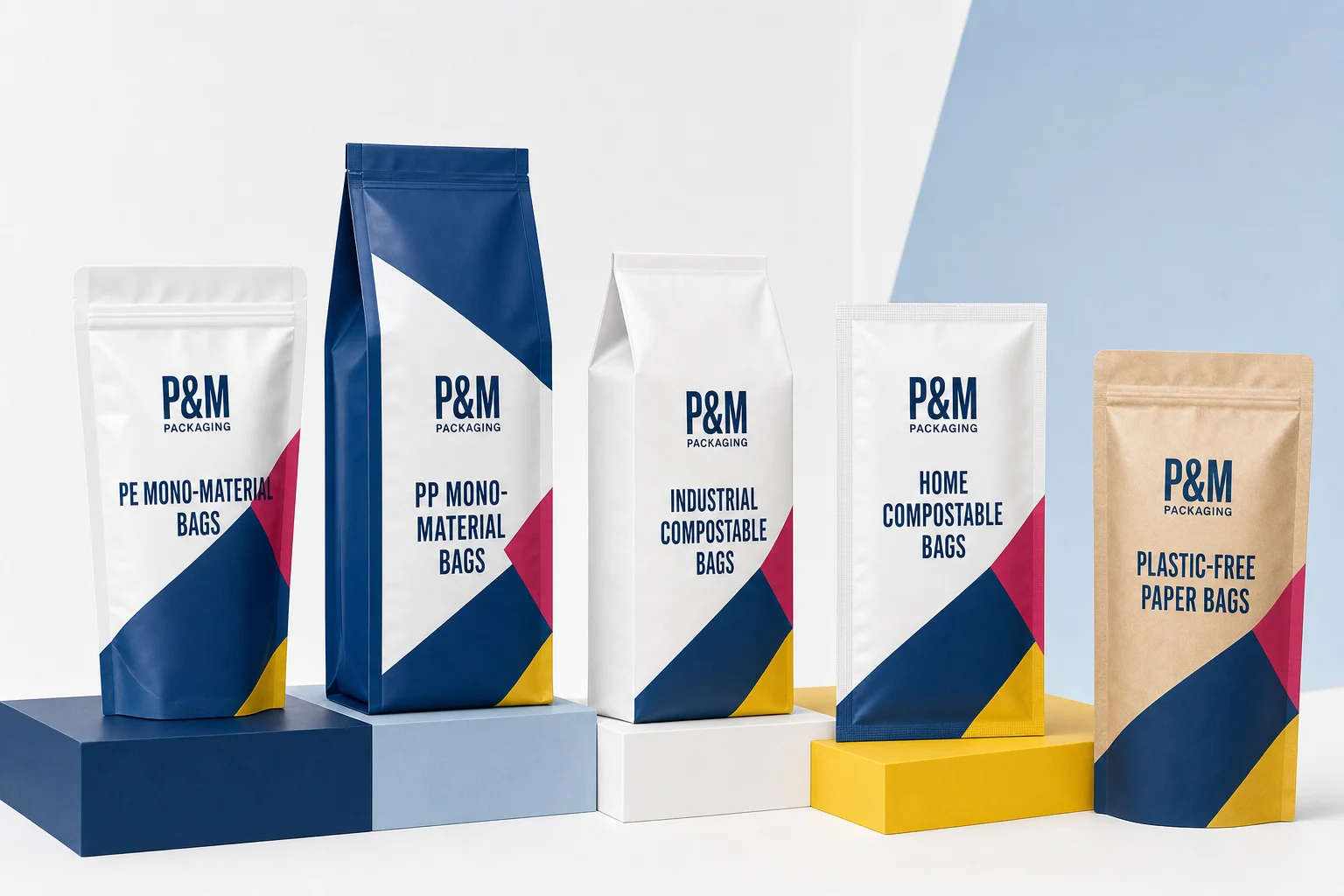
A mono-material pouch keeps the main flexible structure and compatible components predominantly within one polymer family, commonly polyethylene (PE) or polypropylene (PP). That can improve compatibility with a defined recycling stream, but it does not make every pouch automatically recyclable. Barrier layers, coatings, adhesives, inks, zippers, valves, spouts, labels, product residue, local collection, sorting, reprocessing, and the exact marketing claim must all be evaluated for the finished package and market.
What is a mono-material pouch?
Traditional high-performance pouches may combine different polymer, foil, paper, barrier, and sealant layers because each contributes a useful property. A mono-material design reduces incompatible combinations by building predominantly around one compatible polymer family while still delivering the required print, barrier, stiffness, toughness, and sealing performance.
Mono-material describes a design strategy, not a universal composition or disposal instruction. The complete package includes the pouch body, sealant, adhesive or tie layers, coatings, inks, zipper, valve, spout, cap, label, and any other attachment. Even a small component can affect compatibility with a particular collection and reprocessing system.
PE versus PP mono-material packaging
A PE-family pouch may combine grades of polyethylene selected for sealability, toughness, stiffness, print support, and barrier. Flexible PE items may be candidates for an eligible film-collection pathway in some U.S. markets, but curbside and store drop-off access, package design requirements, cleanliness, labeling, and program acceptance must be confirmed.
A PP-family pouch may offer a different balance of stiffness, clarity, heat resistance, and sealing behavior. It should not be represented as following the same collection route as PE film without evidence. Choose PE or PP from the product, filling line, performance target, available recovery pathway, and claim plan—not from the material name alone.
- Required seal initiation and hot-tack performance
- Stiffness, toughness, puncture, and drop resistance
- Oxygen, moisture, aroma, grease, and light protection
- Filling temperature and equipment window
- Zipper, valve, spout, label, and fitment compatibility
- Collection and reprocessing pathway in the intended market
Can recyclable stand-up pouches provide high barrier?
Higher-barrier mono-material concepts are possible, but every added function must remain compatible with the intended recycling stream. EVOH or another barrier layer, metallization, oxide or polymer coating, primer, adhesive, pigment, metallic ink, and surface treatment can change sorting, density, melt filtration, optical quality, or recycled-resin performance.
Do not approve a structure from a generic percentage rule or a single resin datasheet. Request the complete bill of materials, barrier data before and after converting, and any required testing or recognition for the exact construction. Validate oxygen and moisture transmission, aroma or grease protection, seal integrity, flexing, and shelf life with the actual product and process.
Design zippers, valves, spouts, inks, and labels into the system
A PE pouch with an incompatible PP zipper, dense fitment, metallized decoration, paper label, adhesive, or closure can behave differently in collection and reprocessing. Match attachments to the intended stream where technically possible, then assess the complete package rather than declaring the body film recyclable on its own.
Printing and finishing also matter. Ink coverage, dark pigments, metallic effects, varnishes, coatings, laminating adhesives, cold-seal systems, and wash-off or non-wash-off labels may require design review or testing. A window or matte appearance does not prove recyclability, and a recycling symbol should never be copied into artwork before claim eligibility is established.
- Pouch body and inner sealant
- Adhesive, tie layer, coating, and primer
- Zipper, slider, valve, spout, cap, and handle
- Ink system, color, coverage, and metallic effects
- Label stock and adhesive
- Total structure density and reprocessing behavior
Validate package performance before changing materials
Moving from a conventional laminate to a mono-material structure can change stiffness, dimensional stability, coefficient of friction, heat resistance, seal window, hot tack, machinability, puncture behavior, optics, curl, and shelf appearance. Reuse of an old dieline or filling setup without trials can create avoidable risk.
Test the actual product, final package, filling and sealing equipment, storage, distribution, and consumer use. Depending on the application, validation may include barrier and shelf-life work, compatibility aging, seal strength, seal contamination, leak testing, drops, compression, zipper cycles, valve or fitment checks, print rub, blocking, transport simulation, and line trials.
When can a pouch be called recyclable in the United States?
Technical compatibility is only one part of a recyclable claim. The U.S. Federal Trade Commission advises marketers to qualify recyclable claims when appropriate recycling facilities are not available to at least 60 percent of the consumers or communities where the item is sold. Claims and qualifications must be truthful, clear, prominent, and supported for the finished package.
A program label or store drop-off instruction should be used only after the exact package has followed that program's assessment and authorization process. Eligibility can depend on the base polymer, total construction, barriers, coatings, attachments, density, testing, and whether the used pouch can meet the collection program's clean-and-dry requirements.
Account for state-specific labeling requirements
Federal guidance does not replace state law. California's SB 343 implementation page states that its labeling restrictions apply to products and packaging manufactured after October 4, 2026. The law restricts chasing-arrows symbols and other indicators of recyclability unless the applicable criteria are met.
Because requirements, findings, collection access, and labeling programs can change, confirm the intended sales geography and current rules before printing claims or disposal instructions. Retain the assessment, test reports, supplier declarations, label authorization, artwork revision, reviewer, and validity dates in the technical file.
Mono-material pouch RFQ checklist
Start with the product and required protection, then define the environmental goal and market. A technically credible request separates measurable package performance from the claim the brand hopes to make.
Provide the product formulation or relevant chemistry, filling and sealing process, pouch format and dimensions, fill weight, barrier and shelf-life targets, storage and distribution conditions, current structure if known, closure and fitment needs, print and finish, quantity by artwork, sales geography, desired recycling pathway or label, required evidence, test plan, and delivery timing.
- Product, process, and shelf-life target
- PE- or PP-family pathway to be evaluated
- Barrier, seal, toughness, and machinability requirements
- All closures, fitments, labels, inks, and coatings
- Intended U.S. states or other markets
- Proposed claim and consumer disposal instruction
- Testing, assessment, and documentation responsibilities
General educational information only. Materials, performance, compliance, claims, quantities, and timing require confirmation for the exact packaging project.