 WhatsApp
Application scenario · Not a customer case study
Frozen food packaging
Custom Frozen Food Packaging Bags & Rollstock
Custom frozen food bags and printed rollstock for U.S. brands and co-packers, with U.S.-based support and production in P&M's owned Guangdong, China factory. Start with your food, filling line, quantity per SKU, and cold-chain conditions.
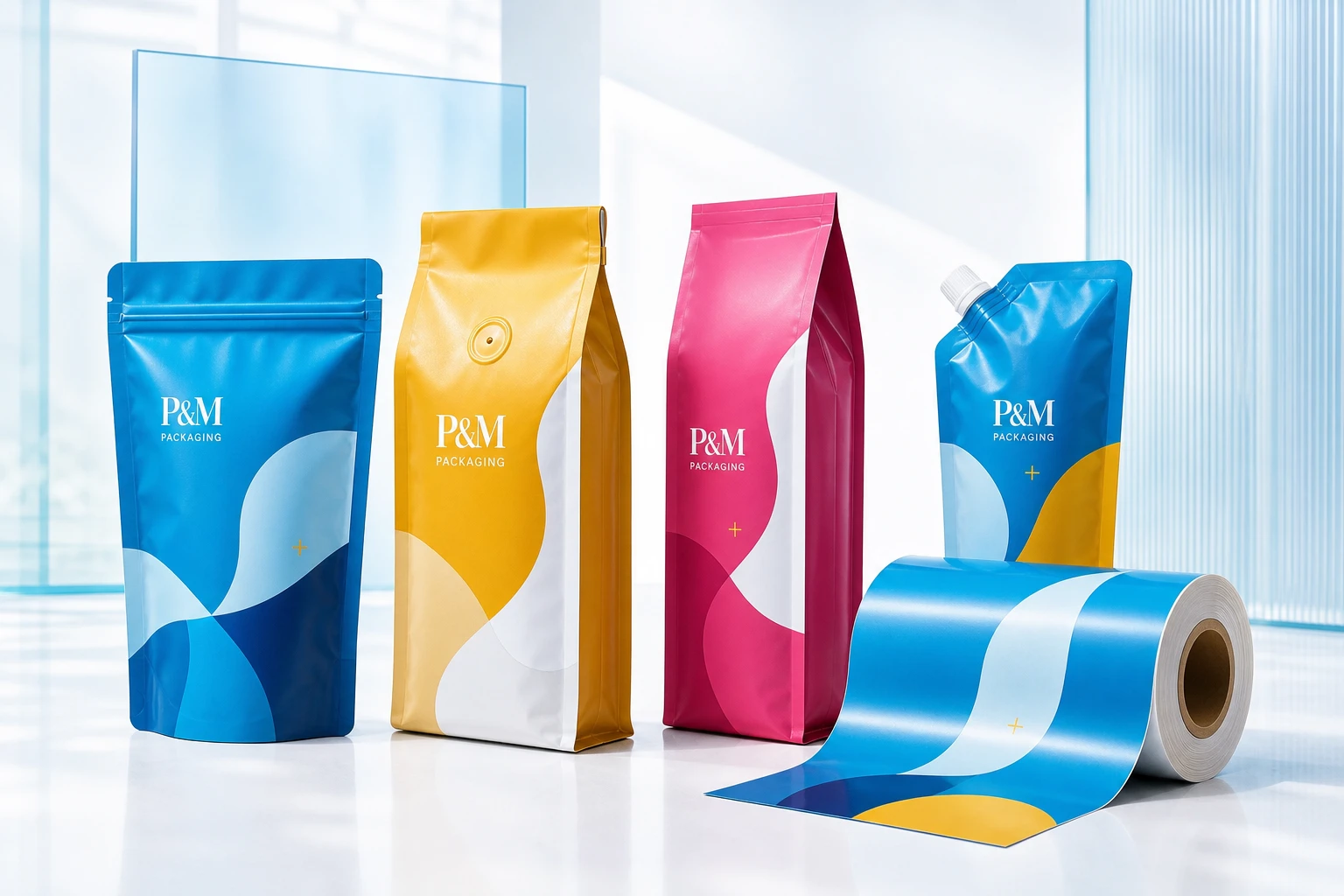
Representative packaging formats, not a tested frozen-food customer pack. Final materials and performance require product- and temperature-specific review
Direct answer
P&M develops custom premade bags and printed rollstock for frozen food brands and co-packers. Premade bags have a general production baseline of 100 units per SKU, subject to the confirmed format, material, and printing route; rollstock quantities and setup are quoted separately. Choose the route your filling line supports, then validate the filled package for the actual freezing, storage, seals, handling, and distribution conditions. A sample or material name alone does not establish frozen-food suitability.
Verified service baselines
Plan your frozen food packaging order
Bring the food, pack size, filling method, temperature conditions, and quantity per design. We can review a new launch, a multi-SKU range, or a supplier-change project before the specification is complete.
- Custom premade bags
- From 100 units per SKUGeneral production baseline; confirm the exact format, structure, and printing route. Printed rollstock quantities and setup are quoted for the project.
- Paid custom sampling
- From 1 pieceHandmade/digital samples typically cost USD 60–100; digital or offset production-process samples typically cost USD 200–500, with no plate fee. Format, material, and size affect the price. Sampling is separate from production MOQ; visual approval does not establish frozen-package performance.
- Printing for multiple SKUs
- Digital, offset, or rotogravureDigital and offset suit multi-SKU and market-testing programs, with no plate fee charged to the customer. Confirm the route for the actual format, material, and quantity per design. Rotogravure setup and plate charges are quoted separately.
- Production planning
- Production and freight are separateGeneral production estimates are 7–10 days for digital or offset orders up to 50,000 units total, and 10–15 days for rotogravure. Materials, approvals, specialty processes, and quantity can change timing. Confirm samples, frozen-package trials, production, and delivery dates separately in your quote.
- Production and support
- China factory · U.S. teamP&M owns its Guangdong factory and provides U.S.-based service. Los Angeles warehousing and delivery planning concern packaging inventory; frozen-food storage and cold-chain transport are not included in that service claim.
- Approval before production
- Validate the filled packageConfirm the food, temperature range, fill weight, seals, handling, and test plan. Material, sample, and production approval must match the intended use.
Start with your need
What needs to happen next?
No finished specification required. Send a product or reference photo on WhatsApp.
Frozen Food Packaging Bags
Premade stand-up, flat, gusseted, and other bags reviewed around the food, fill weight, low-temperature flexing, seals, opening, and storage.
Explore custom frozen food bags →Printed Frozen Food Rollstock
Frozen food packaging film coordinated around VFFS, HFFS, or flow-wrap equipment, web, repeat, sealant, registration, coding, unwind, product drop, and cold storage.
Explore printed frozen food rollstock →Cartons & Paperboard Sleeves
Paperboard cartons and sleeves planned around the primary pack, moisture exposure, freezer storage, required panels, and retail display.
Explore frozen food boxes →Corrugated Cases & Pack-Out
Case count, bag orientation, compression, condensation, warehouse conditions, palletization, and distribution guide the secondary pack.
Explore shipping cases →One-stop frozen food packaging solution
Coordinate the frozen primary pack, retail carton, and distribution case.
Frozen food packaging can combine premade bags or rollstock, folding cartons, and corrugated cases. P&M organizes the system around the food, filling and freezing process, low-temperature behavior, moisture, handling, and route to market.
Discuss this applicationSend the product, format, quantity, and current challenge.
View the complete packaging system and approval inputs
Primary package
Frozen food bags or rollstock
Food, fill weight, low-temperature flexing, puncture, seals, moisture, filling equipment, and storage guide the flexible specification.
Explore format Retail layerFolding cartons
Primary-pack fit, information panels, freezer storage, opening, shelf presentation, and production pack-out guide the carton.
Explore format Distribution layerCorrugated frozen pack-out
Case count, temperature, moisture, orientation, compression, palletization, warehouse handling, and route guide the case.
Explore formatWhat to bring
Inputs for the first packaging review
- Food type, shape, edges and fill weight
- Filling temperature and freezing route
- Storage range and temperature cycling
- Moisture, barrier and shelf-life targets
- Packing equipment and coding
- Channels, case count, quantities and timing
What to confirm
Verification before production
- Food-contact documentation for conditions of use
- Low-temperature flexing and puncture review
- Seal integrity and filling-line trials
- Carton fit, moisture and print checks
- Filled-pack distribution and pallet testing
View more technical specifications 7 sections
Frozen food rollstock for VFFS, HFFS, and flow-wrap lines
Vertical form-fill-seal film may be used for vegetables, fruit, fries, prepared foods, and other supported formats; horizontal form-fill-seal or flow-wrap film may suit bars, portions, or trays. Film structure is not selected from equipment type alone: product edges, oil or moisture, sealing temperature, contamination, freezing route, package geometry, coding, speed, and cold-chain handling all affect the final specification.
VFFS frozen food film
Coordinate web, repeat, forming collar, sealant, coefficient of friction, product drop, jaws, coding, and filled-package testing.
Explore VFFS rollstock →HFFS and flow-wrap film
Coordinate product presentation, fin or lap seals, end seals, registration, cut-off, coding, speed, and low-temperature handling.
Explore HFFS and flow-wrap film →Prepare a frozen food packaging quote
Send what you know and identify any open decisions. A reference bag, drawing, or product photo can help start the review; the final structure and price still need a project specification.
- Food type, product shape or sharp edges, and filled weight
- Packing temperature, freezing sequence, storage range, and expected temperature cycling
- Premade bag format or the co-packer's rollstock machine, web, repeat, and unwind requirements
- Bag dimensions, artwork versions, and quantity for each SKU
- Current seal, puncture, cracking, opening, or handling problem, if any
- Sample purpose, required delivery date, destination ZIP code, and shipping or inventory plan
Separate sample approval from frozen-package validation
A visual or dimensional sample can help approve artwork and fit. Frozen-use approval needs the actual structure, food or agreed representative fill, filling process, seals, and temperature conditions. For a project that calls for -18°C drop testing, test the filled pouch directly at that temperature rather than only after it has warmed to room temperature. Record the fill weight, conditioning, drop height, orientation, number of drops, sample plan, and agreed acceptance criteria. This is a project test-planning requirement, not a claim that every P&M pouch has passed the same test.
Frozen food packaging starts with temperature and process
Share the food, fill weight, filling method, temperature at packing, freezing route, storage range, thaw exposure, expected shelf life, distribution, quantities, and intended market.
- Frozen fruit and vegetables
- Prepared meals and side dishes
- Frozen bakery and dessert products
- Meat, seafood, and plant-based products
- Retail, foodservice, club, and ecommerce formats
Review low-temperature flexing, seals, and moisture
Material stiffness or brittleness, flex cracking, puncture, seal integrity, product edges, ice crystals, condensation, moisture, freezer handling, and temperature cycling can affect the complete package. Testing should represent the filled product and intended conditions.
Match bags or rollstock to filling equipment
Premade bags and form-fill-seal rollstock require different dimensions, seal areas, web or roll specifications, coding positions, product-drop control, and line trials. Confirm the co-packer or filling-line requirements before artwork approval.
Coordinate retail and distribution packaging
Primary bags, folding cartons, paperboard sleeves, display formats, and corrugated cases can be planned as one system while each component retains its own moisture, temperature, fit, print, testing, and production requirements.
Packaging Knowledge Center
Professional guides for this application
Use these practical articles to prepare specifications, identify project risks, and ask better questions before sampling or production.
View 5 more related guides
Frequently asked questions
What is the minimum order for custom frozen food bags?
For custom premade bags, P&M's general production baseline is 100 units per SKU, subject to confirmation of the format, material, and printing route. List the quantity for each design separately. Printed rollstock quantities and setup are quoted for the exact project; the premade-bag baseline does not apply to rollstock.
Can I order a sample before committing to production?
One-piece paid custom sampling is available. Digital and offset samples typically take 7–10 days; rotogravure samples typically take 10–12 days, with plate fees quoted separately. Confirm the method, cost, and schedule for your format, material, and size, and allow separately for shipping and trials. Define whether the sample is for artwork, dimensions, filling, or performance work. A visual sample does not prove low-temperature suitability; validate the actual filled package under the agreed cold conditions before production.
Where does P&M produce frozen food packaging?
P&M's custom flexible packaging production is based in its owned Guangdong, China factory, with U.S.-based service personnel. Discuss the packaging shipment, destination, delivery date, and any packaging inventory needs when requesting a quote. This is not a claim of U.S. manufacturing or frozen-food cold-storage service.
View 4 more questions
What type of packaging is used for frozen food?
Common paths include premade flexible bags, printed rollstock, folding cartons, paperboard sleeves, and corrugated cases. The right system depends on the food, filling and freezing process, storage temperature, moisture, seals, handling, distribution, quantity, and shelf-life target.
Can the same pouch material be used for ambient and frozen products?
Not automatically. Low-temperature stiffness, flexing, puncture, seals, moisture, condensation, product edges, storage, and distribution may require different structures and testing.
Should frozen food use premade bags or printed rollstock?
Use the route supported by the product and filling line. Premade bags arrive already converted; printed rollstock is formed, filled, and sealed on VFFS, HFFS, flow-wrap, or other equipment. Format, speed, web and repeat, product drop, seals, coding, low-temperature performance, quantity, and trials guide the decision.
Can P&M coordinate frozen food bags, cartons, and cases?
Yes. The components can be planned as one packaging system while each maintains its own materials, dimensions, artwork, equipment, testing, and approval requirements.