 WhatsApp
Printed Stand-Up Bags
Artwork, print route, windows, coding areas, quantities, and color approval are coordinated with the approved structure.
Custom stand-up pouch packaging
Custom stand-up pouches are printed premade pouch bags developed around the product, fill weight, bottom gusset, barrier, filling and sealing, zipper or fitment, shelf stance, artwork count, order quantity, and distribution.
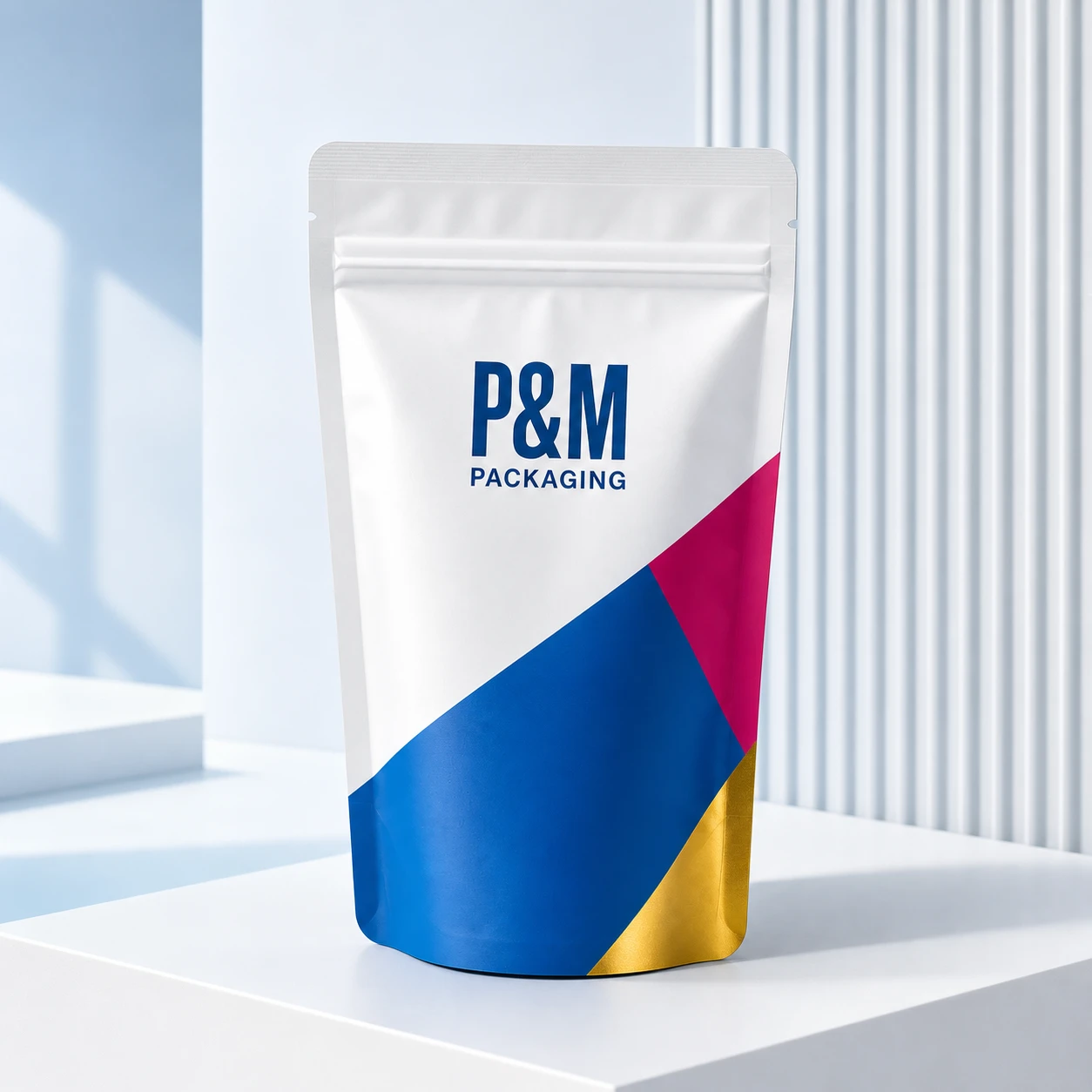
AI-generated representative rendering—not a customer product, production sample, or proof of a specific material, finish, or performance. The exact package requires project review.
Direct answer
Custom stand-up pouches are premade flexible bags with a bottom gusset that opens into a self-supporting base. A paid custom sample can start from 1 piece, and the general production baseline starts from 100 pieces per SKU. Digital, offset, and rotogravure printing can be matched to the artwork count, quantity, material, finish, and repeat-order plan. P&M coordinates China owned-factory production with U.S.-based project support and Los Angeles warehousing; the final dimensions, film, zipper or fitment, seals, filling route, testing, lead time, and price remain specification dependent.
Verified service baselines
These are current general service baselines. The quotation confirms the exact pouch size, material, printing route, features, quantity by SKU, testing, production schedule, and delivery plan.
Fast project review
Share the project essentials. The U.S. team targets a reply within 12 hours and a quotation within 24 hours once the project is sufficiently defined.
Buyer comparison
The pouch name identifies the format; product protection and line compatibility come from the complete dimensions, laminate, seals, closure or fitment, filling process, and validation plan.
| Format | Best fit | What can be customized | Critical checks |
|---|---|---|---|
| Resealable zipper pouch | Snacks, coffee, pet treats, qualified dry products, and products used more than once | Pouch size, bottom gusset, qualified zipper, tear feature, hang hole, material, print, and window | Usable opening, product particles, fill line, top seal, zipper cycles, barrier, and shelf stance |
| Stand-up pouch with window | Products where controlled visibility supports shelf selection | Window shape and position, zipper, material, print, and approved artwork areas | Light sensitivity, barrier loss, seal clearance, window registration, product appearance, and evidence for any material claim |
| Valve stand-up pouch | Coffee and other qualified products that require a reviewed venting route | Valve type and position, zipper, barrier structure, pouch size, material, and printing | Product behavior, valve opening, oxygen path, fill level, top seal, leak performance, storage, and shelf-life validation |
| Spouted stand-up pouch | Qualified liquid and refill projects reviewed for the exact product and filling process | Spout bore, flange, position, cap, pouch geometry, material, and printing | Chemistry, viscosity, particles, filling temperature, fitment weld, cap torque, drops, leaks, opening, and process compatibility |
Premade stand-up pouches run on a compatible filling and final-sealing route. Printed rollstock is a different supply system formed into packages on approved form-fill-seal equipment.
Start with your need
No finished specification required. Send a product or reference photo on WhatsApp.
Qualified zipper concepts are reviewed around product behavior, usable opening, filling, seals, and repeated use.
Review zipper selection factors →Artwork, print route, windows, coding areas, quantities, and color approval are coordinated with the approved structure.
One-way degassing valves, spouts, caps, tear features, hang holes, and handles are evaluated around product, seals, fill level, equipment, and use.
Explore pouch features →Retail cartons, multipacks, shelf displays, ecommerce boxes, and shipping cases coordinated around the filled stand-up pouches.
Explore secondary packaging →A stand-up pouch can look correct on a flat proof and still fail after filling. Shelf stance, zipper access, seal cleanliness, opening force, product fit, artwork position, and case packing should be reviewed on the filled package before the production order is approved.
Check fill weight, bulk density, bottom-gusset deployment, product distribution, material stiffness, dimensions, fill level, and the shelf or case footprint.
Review pouch size and headspace →Review usable opening width, zipper profile, product particles, fill line, tear position, top seal, flange alignment, and repeated-use testing.
Review zipper selection →Separate product control, clean seal area, sealant choice, jaw settings, dwell, cooling, inspection, and leak testing instead of changing film thickness alone.
Troubleshoot pouch leaks →Approve graphics across the gusset, curves, zipper, seals, folds, coding area, product bulge, finish, and actual shelf-facing condition.
Prepare pouch print and color →Share the product, fill weight, bulk density or fill volume, desired dimensions, filling method, storage, shelf-life target, quantities, artwork, and intended channel.
Width, height, bottom gusset, seal areas, zipper position, headspace, product density, fill level, and package weight determine usable volume and shelf behavior. Nominal dimensions alone do not prove product fit.
Oxygen, moisture, aroma, oil, light, puncture, stiffness, seal contamination, opening, reclosure, valve or spout, filling, storage, and distribution guide the complete structure. Bag shape does not determine material performance.
Digital and offset printing can avoid plate fees for qualified projects and support shorter runs or multi-SKU stand-up pouch programs. Rotogravure is commonly reviewed for larger repeat volumes and selected color or material requirements. Compare total program cost, quantity per artwork, repeat frequency, color targets, material availability, setup, and converting minimums rather than choosing a print process from unit price alone.
The current general production baseline starts from 100 pieces per SKU, but there is no universal minimum for every printed stand-up pouch specification. MOQ can change with finished size, film structure, print route, quantity per design, zipper or fitment, finish, lamination, pouch conversion, and production scheduling. A useful quotation lists every size and artwork separately and identifies whether multiple designs can share one material and production setup.
A paid one-piece sample is separate from production MOQ. The quotation should identify whether the sample is intended to review dimensions and appearance, the selected production print route, or a project-specific performance question. Product fit, shelf stance, filling access, seals, zipper cycles, accessory placement, opening, drop or distribution, print color, coding, and line compatibility may require different samples or trials before production approval.
Packaging Knowledge Center
Use these practical articles to prepare specifications, identify project risks, and ask better questions before sampling or production.
Stand-up pouches can be considered for foods, snacks, coffee, pet treats, qualified dry products, and qualified liquid or refill projects. Final suitability depends on the exact product, filling, structure, closure or fitment, storage, distribution, and validation.
Size depends on fill weight or volume, bulk density, product dimensions, headspace, bottom-gusset deployment, zipper and top-seal position, filling access, shelf stance, and consumer use. Product-fit samples are recommended.
Potentially. Each feature must be reviewed with the barrier target, seals, filling equipment, product, print, placement tolerances, package geometry, testing, and order requirements.
The current general production baseline starts from 100 pieces per SKU, while a paid custom sample can start from 1 piece. The exact production MOQ depends on pouch size, material, print process, quantity per artwork, zipper or fitment, lamination, finish, and converting setup. Confirm the quantity for the exact specification.
Digital and offset printing are often evaluated for shorter runs, multiple designs, and qualified projects where avoiding plate fees helps. Rotogravure can be more suitable for larger repeat orders and selected color or material requirements. The best route depends on total quantity, quantity per SKU, repeat plan, structure, approved artwork requirements, setup, and budget.
Common causes include an undersized or poorly deployed bottom gusset, unsuitable width-to-height ratio, fill level, low or uneven product density, trapped air, material stiffness, product settling, or case and shelf conditions. Confirm stance with the actual product, closure, top seal, and representative filled-package handling.
Premade stand-up pouches arrive converted with the bottom gusset and optional zipper or fitment, then run on compatible premade-pouch filling equipment. Printed rollstock is formed, filled, and sealed on VFFS, HFFS, or related equipment. Product, package style, speed, equipment, seals, coding, quantity, and trial results determine the route.