 WhatsApp
Production Baseline from 100 / SKU
The general production baseline starts from 100 pieces per SKU; the exact minimum remains subject to size, structure, artwork, finish, and production route.
Custom kraft paper pouches
Bring your brand to kraft with full-color printing for coffee, tea and snacks. Digital and offset printing have no plate fees. Production generally starts from 100 pouches per SKU, with the exact structure, minimum and finishing costs confirmed in your quote.
Direct answer
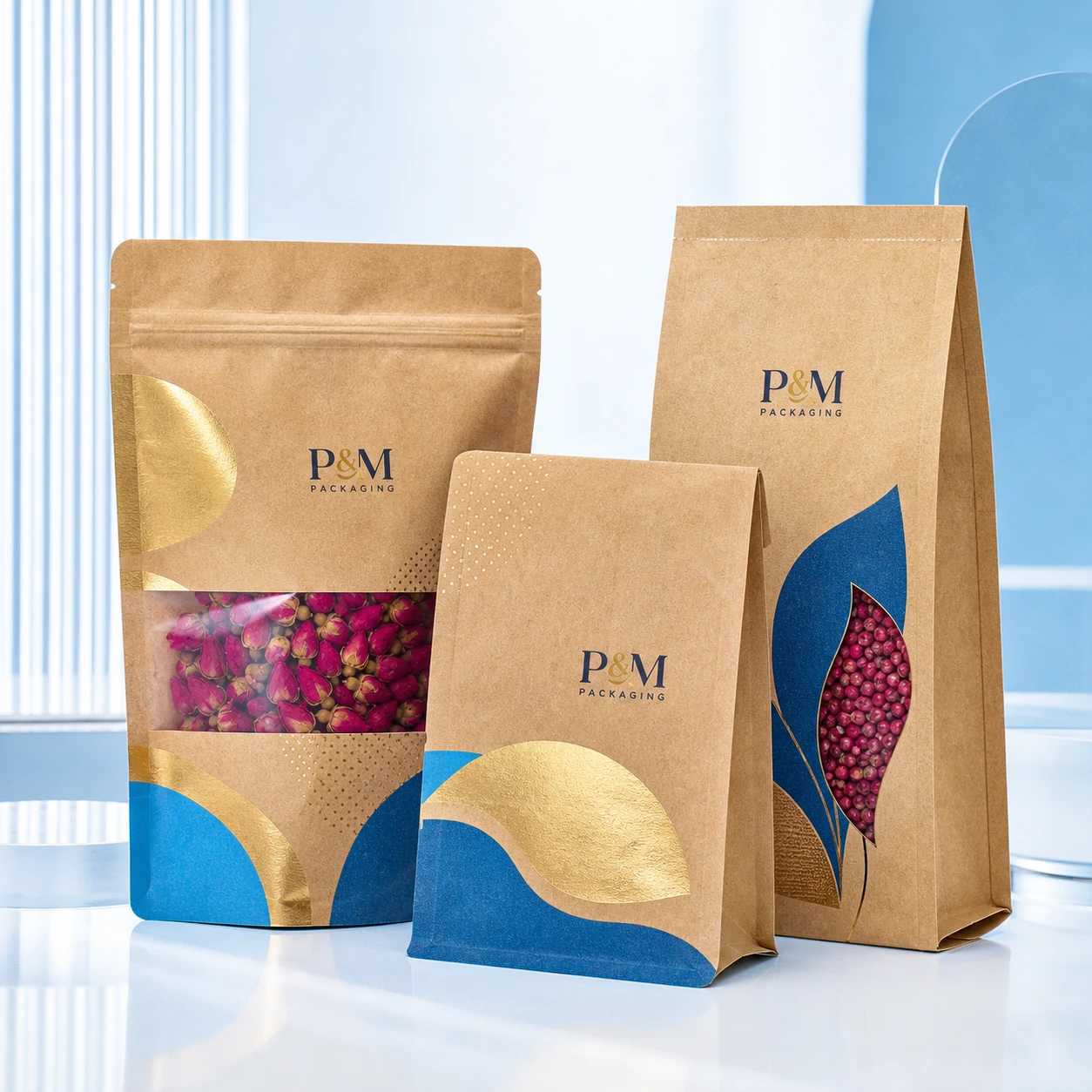
P&M develops custom printed kraft paper pouches for coffee, tea, nuts and snacks, dry pet food and treats, protein powders, and other compatible products. Formats include stand-up zipper pouches, flat-bottom kraft bags, side-gusset bags, and window pouches. A paid custom sample can start from 1 piece and the general production baseline starts from 100 pieces per SKU. Digital and offset production have no plate fee; the exact structure, print route, minimum, timing, and price are confirmed for each project.
Verified service baselines
These are current service baselines, not universal promises for every kraft construction. The quotation confirms the product, size, material, print route, quantity per SKU, features, testing, production timing, and delivery plan.
Fast project review
Share the project essentials. The U.S. team targets a reply within 12 hours and a quotation within 24 hours once the project is sufficiently defined.
Buyer comparison
Choose the format from the product, fill weight, opening, reclosure, filling method, shelf presentation, case pack, and cost—not from the paper appearance alone.
| Format | Best fit | Filling route | Critical checks |
|---|---|---|---|
| Stand-up zipper pouch | Snacks, nuts, powders, tea, pet treats, and compact coffee packs | Premade-pouch filling and final top sealing | Bottom gusset, zipper access, fill level, window, shelf stance, and seal clearance |
| Flat-bottom kraft bag | Premium coffee, snacks, pet treats, and products needing a structured shelf profile | Premade-bag filling and final top sealing | Base geometry, five-panel artwork, valve or zipper, headspace, and case pack |
| Side-gusset bag | Coffee, dry pet food, grains, and larger dry-product volumes | Compatible premade-bag filling and closing process | Gusset capacity, closure, valve, package weight, handling, and palletization |
| Three-side-seal pouch | Samples, portions, flat products, and compact barrier packs | Fill through the open side, then apply the final seal | Usable opening, product edges, seal area, tear feature, coding, and pack-out |
A kraft-faced spouted pouch for liquids is a separate product-compatibility and fitment project; a dry-product kraft pouch should not be assumed suitable for liquid filling.
Start with your need
No finished specification required. Send a product or reference photo on WhatsApp.
A practical sourcing path for first launches, multi-SKU ranges, retail or ecommerce growth, planned scale-up, and supplier-change projects.
Review a kraft pouch project →The general production baseline starts from 100 pieces per SKU; the exact minimum remains subject to size, structure, artwork, finish, and production route.
Digital and offset printing have no plate fee charged to you. Compare routes for multiple artworks and shorter runs; samples and specialty finishing are quoted separately.
Develop CMYK graphics, opaque white ink, hot foil, selective UV, matte, gloss, or tactile effects around the actual kraft face and production route.
Explore printing and finishing →Coordinate reclosure, product-view windows, tear features, fill line, top seal, light exposure, barrier, and artwork as one finished-bag specification.
Explore stand-up zipper bags →Combine a stable box-shaped base and five print panels with natural, white, or black kraft, subject to product fit, barrier, zipper, valve, filling, and case pack.
Explore flat-bottom bags →Flat-bottom kraft paper bags use a stable box-shaped base and broad front, back, and side panels for shelf presentation and printing. Kraft stand-up pouches use a bottom gusset to create a lighter, efficient shelf-standing format. Choose between them using fill weight, product density, stability, usable opening, valve or zipper placement, packing method, case pack, and target price—not appearance alone.
P&M can develop more than simple one-color text on kraft paper. Qualified projects can use full-color CMYK four-color-process graphics, opaque white ink, hot foil stamping, selective UV, matte or gloss effects, embossing, and custom window designs. Colors appear darker and softer on natural brown kraft, white kraft provides a brighter print base, and black kraft often needs opaque white or metallic elements for contrast. Approve color, adhesion, rub resistance, foil, and coating effects on the actual paper and structure.
Start with what you pack and how many designs you need. Match the paper appearance, printing, closure and barrier to each product before approving a sample.
Build a consistent look across origins and roast profiles. Coordinate the stand-up or flat-bottom format, degassing valve, zipper and aroma barrier with your filling process.
Explore coffee packaging →Give each blend its own artwork while keeping the range recognizable. Review moisture protection, aroma retention, opening size and quantity per design.
Explore tea packaging →Compare a printed front with an optional product window. Select the bag format, reclosure, grease resistance and barrier for the food and shelf-life target.
Explore snack packaging →Match the package weight, puncture resistance, grease and aroma barrier, zipper, handling, and case pack to the exact kibble, treat, or supplement product.
Explore pet food packaging →Review bulk density, fill level, scoop access, moisture barrier, powder in seals, zipper placement, and quantity per flavor before finalizing dimensions.
Explore powder packaging →A kraft face may be evaluated on a compatible spouted structure, but product chemistry, fitment, seals, drops, leakage, filling, and transport must be validated separately.
Explore liquid refill packaging →The route is selected after the pouch format, dimensions, material, artwork, finish, total quantity, and quantity per SKU are known. For the same approved bag format, dimensions, structure, and artwork conditions, P&M assesses the digital-to-offset crossover within 2,500–5,000 units per SKU and the offset-to-rotogravure crossover within 20,000–50,000 units per SKU. These are project-specific comparison bands—not universal capability limits—and the quotation sets the actual crossover points.
Usually compare digital at or below the assessed digital-to-offset crossover. It has no plate fee and can reduce versioned inventory risk for lower-volume or multi-artwork programs.
Usually compare offset above the assessed digital crossover and through the assessed offset-to-gravure crossover. Offset production has no plate fee; the approved material, color, finish, setup, and repeat plan still govern.
Usually compare rotogravure at or above the assessed offset-to-gravure crossover. Cylinder or plate costs, repeat demand, color targets, material, and total program economics are confirmed in the quote.
At a quoted crossover, compare the applicable routes on total landed program cost, inventory exposure, color and finish requirements, repeat forecast, timing, and approval risk—not unit price alone.
This service is designed for companies developing or purchasing packaging for their own branded products. It supports a first launch, multiple flavors or sizes, retail or ecommerce expansion, planned volume growth, and supplier changes caused by barrier, seal, zipper, color, inventory, or delivery problems.
A kraft paper pouch is a flexible bag with a natural brown, white, or black kraft paper outer face. Many food, coffee, snack, and pet-treat applications laminate the paper to sealant and barrier layers, while separately engineered paper-dominant structures follow a different pathway. The complete construction—not the kraft appearance alone—determines sealing, moisture and oxygen protection, shelf life, food-contact suitability, and any reduced-plastic or plastic-free claim.
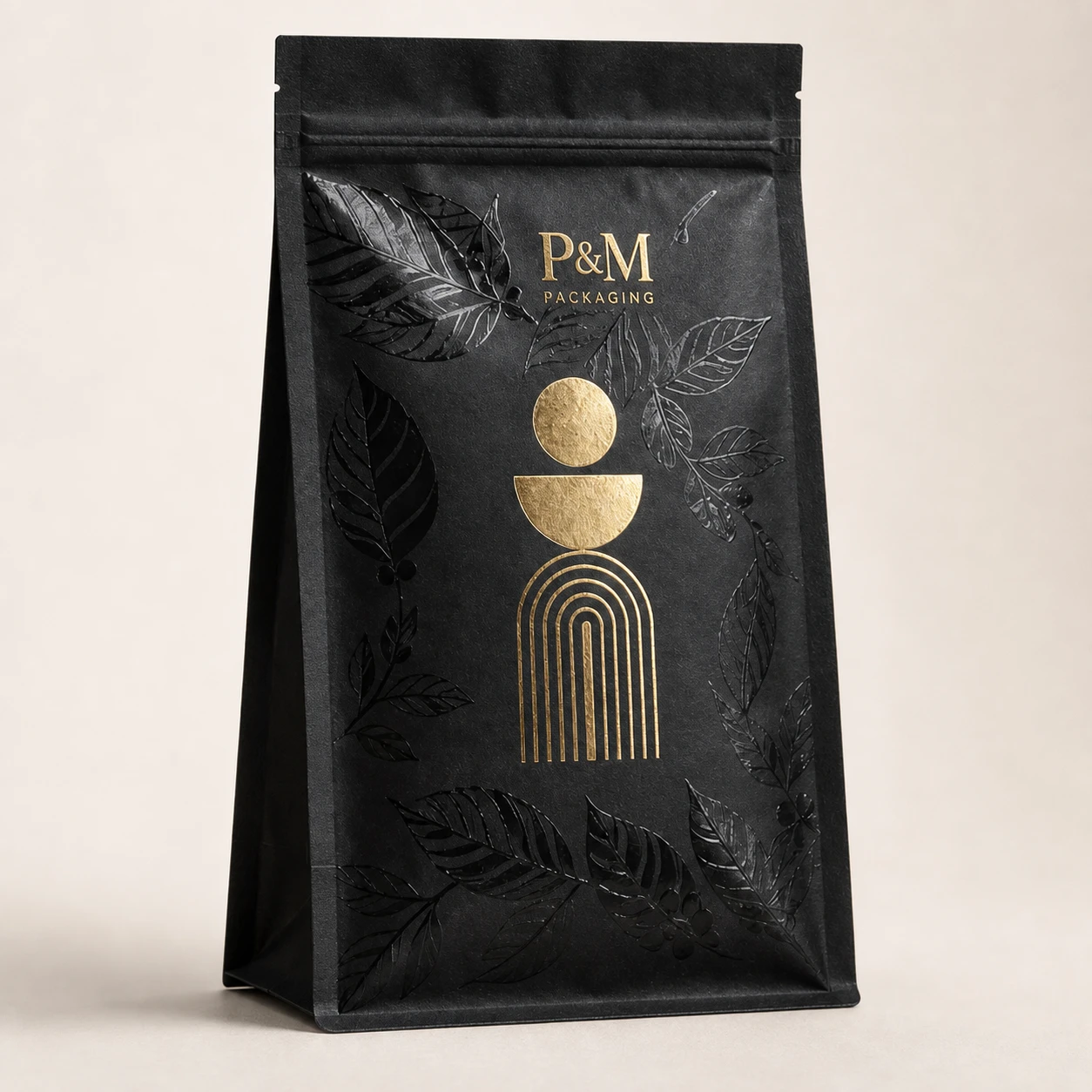
Choose the kraft face around the intended shelf appearance and print result. Natural brown kraft provides visible fiber and muted color; white kraft creates a brighter base for full-color graphics; black kraft paper bags create a premium dark surface that can use opaque white ink, metallic foil, and selective UV for contrast. Confirm whether the project uses black-dyed or black-coated paper, or a printed black ink field, because the material, color consistency, scuff behavior, and artwork preparation differ.
Natural brown or unbleached kraft paper creates the familiar craft appearance used by brown kraft paper bags, coffee bags, snack pouches, pet-treat bags, and other natural-positioned packaging.
White or bleached kraft paper gives custom printed kraft paper bags a cleaner, brighter print base for CMYK graphics while retaining paper texture. Color targets are approved on the actual material.
Black kraft paper bags create strong contrast for premium coffee, snacks, cosmetics, apparel, and specialty goods. Opaque white ink, gold or silver foil, and selective UV can be evaluated on the actual black surface.
A kraft paper laminate combines the paper face with heat-seal and barrier layers. The complete structure—not the paper layer alone—determines moisture, oxygen, grease, aroma, and sealing performance.
Metallized-film or aluminum-foil layers may be used behind kraft paper for stronger oxygen, moisture, aroma, and light protection. The exact high-barrier kraft pouch structure is matched to the product and shelf-life target.
Paper-dominant and plastic-free paper bag concepts follow a separate material pathway from conventional kraft-film laminates. Heat sealing, barrier, certification evidence, and disposal claims must be confirmed for the exact structure.
Compare eco-friendly bag pathways →Kraft paper zipper pouches provide convenient opening and reclosure for coffee, tea, snacks, powders, pet treats, and other dry products. Standard press-to-close zippers are common, while easy-open, child-resistant, and hook-and-loop closures may be evaluated for qualified structures. Zipper profile, opening width, fill line, tear notch, top seal, powder contamination, repeated use, and the intended filling process must work together.
A kraft paper ziplock bag with a window combines product visibility with a printable paper face and resealable stand-up format. Rectangle, narrow strip, or custom-shaped windows can be reviewed around the artwork, product size, light sensitivity, barrier target, and seal areas. A conventional clear plastic window changes the bill of materials and prevents an unqualified plastic-free claim; paper-dominant transparent or barrier concepts require separate evidence and performance review.
Kraft paper can replace a conventional PET or BOPP print web in some laminated structures and may allow the PE or CPP sealant layer to be right-sized after performance validation. This can support a measured plastic-reduction program, but a conventional kraft-film laminate is not plastic-free. Plastic-free paper concepts require the exact paper, barrier and heat-seal coatings, inks, adhesives, zipper, window, foil, and UV components to be reviewed together before making a claim.
Kraft paper changes color, texture, scuff behavior, barrier choices, accessory compatibility, and environmental claims. Resolve the material and finished-bag specification before treating a natural-paper appearance as proof of performance or sustainability.
Natural kraft becomes part of every unbacked color. Use white kraft, an opaque white underbase, stronger contrast, controlled spot colors, or intentional paper-colored negative space.
Compare kraft printing routes →Confirm whether the surface is black-dyed, coated, or printed, then evaluate opaque white ink, metallic foil, selected colors, UV contrast, adhesion, and rub resistance.
Prepare black kraft artwork →Audit the barrier and sealant films, coatings, adhesive, ink, zipper, window, valve, foil, UV, and label before making a reduced-plastic or plastic-free claim.
Review plastic reduction →Review the accessory material, window size and position, light sensitivity, barrier target, seal zones, closure cycles, and complete-package evidence.
Compare paper packaging pathways →The general production baseline starts from 100 pieces per SKU. Actual minimums depend on bag dimensions, kraft face, layer structure, format, closure, window, valve, finish, quantity per artwork, and production route. Qualified digital and offset projects can avoid conventional plate fees; rotogravure plate fees and finishing tooling are confirmed in the quotation. Grease, moisture, oxygen, aroma, food contact, seals, filling, transport, and shelf life are confirmed for the finished specification before production approval.
P&M coordinates production through its owned factory in Guangdong, China, with U.S.-based project support and a self-operated Los Angeles warehouse. The factory includes three HP Indigo digital presses, including one HP Indigo 200K, plus Vision 520 web offset, rotogravure, dry lamination, rewinding inspection, and bag-making equipment. Available project checks can include laminate bond strength, leakage, raw materials, solvent residue, dimensions, thickness, print color, seal-edge dimensions, zipper strength, and drop or load testing. The approved kraft pouch and acceptance criteria determine which checks apply.
Packaging Knowledge Center
Use these practical articles to prepare specifications, identify project risks, and ask better questions before sampling or production.
The general production baseline starts from 100 pieces per SKU, while a paid custom sample can start from 1 piece. Actual MOQ depends on dimensions, format, material structure, zipper, window, valve, finish, production route, total quantity, and quantity per artwork, and is confirmed at quotation.
Digital and offset production do not have a plate fee. Rotogravure plate or cylinder fees are quoted for the approved design and route. For one individual design, the corresponding rotogravure plate fee is waived when that design's cumulative product charges exceed 20 times its plate fee within one year starting from that design's first order date. Freight and plate fees do not count toward the threshold, and unrelated designs are not pooled. A previously paid qualifying plate fee becomes a non-cash credit with no usage expiry and can be applied to subsequent product charges, freight, or plate fees. Taxes and sample-fee treatment remain subject to the quotation and applicable rules; any design change is reviewed separately.
Yes, but artwork must be developed for the dark surface. Opaque white ink, metallic foil, selective UV, and carefully selected colors can create strong contrast. Standard CMYK inks are transparent, so accurate or bright full-color graphics may require a white underprint or a white kraft alternative. Approve the result on the actual black paper.
Not automatically. Most kraft pouches are paper-film laminates, and any recyclable, compostable, or plastic-free claim must be supported by evidence for the exact structure, components, and target market's recovery system. If environmental positioning matters, compare kraft laminate against mono-material, compostable, and plastic-free paper pathways before choosing.
Opaque white ink can be evaluated for qualified black kraft paper bags and used alone or beneath selected colors. Opacity, adhesion, rub resistance, finish, registration, and the exact black paper or coating must be confirmed during artwork and sample review.
Yes, qualified kraft paper zipper and ziplock bag formats can include rectangle, strip, or custom-shaped windows. Window film, position, size, zipper, seals, light sensitivity, barrier, and artwork are reviewed as one specification. A conventional plastic window means the finished bag should not be described as plastic-free.
A stand-up pouch normally uses a bottom gusset to form its base and can provide an efficient material-to-volume ratio. A flat-bottom bag uses a box-shaped base and defined side panels for greater shelf stability and printable area. Product density, fill weight, zipper and valve needs, filling, case pack, appearance, and price determine the better format.
Yes, where the selected format and structure support both features. The valve type and position, zipper, usable opening, fill line, roast timing, gas release, barrier, seals, and filling process must be confirmed together. Reclosure after opening does not replace the original coffee barrier and seals.
Usually not by default. Many kraft paper ziplock bags use plastic barrier films, sealant layers, zippers, windows, coatings, or adhesives. A plastic-free claim requires review of the complete bill of materials and supporting evidence for the intended market; the kraft paper appearance alone is not proof.
For the same approved bag format, dimensions, structure, and artwork conditions, P&M assesses a digital-to-offset crossover within 2,500–5,000 units per SKU and an offset-to-rotogravure crossover within 20,000–50,000 units per SKU. Digital is normally compared at or below the first project-specific crossover, offset between the two, and rotogravure at or above the second. These are comparison bands rather than fixed capability limits, so the quotation confirms the actual route and crossover points.
Potentially, but a conventional dry-product kraft pouch should not be assumed suitable. A kraft-faced spouted or refill pouch must be developed around the exact formula, product compatibility, barrier, fitment and cap, sealant, filling temperature and equipment, storage, drop and leak performance, transport, and consumer use. The paper face does not determine liquid compatibility.
Send the product, fill weight or volume, current or preferred pouch format, dimensions if known, kraft color, barrier and shelf-life target, zipper, valve, window or spout needs, quantity for each size and artwork, annual forecast, artwork status, filling method or co-packer requirements, sales channel, delivery destination, target date, and any problem with the current package.
Hot foil stamping, selective or spot UV, matte, gloss, tactile, and embossed effects can be evaluated subject to the paper face, inks, coating, structure, print route, and converting process. Not every finish is compatible with every plastic-free or recyclable claim, so the finished construction must be reviewed.
Many kraft paper pouches combine a brown or white kraft outer layer with printed inks, adhesive, barrier film, and an inner heat-seal layer. Some structures add metallized film or aluminum foil for higher barrier. Paper-dominant and plastic-free concepts use different structures and should be evaluated separately.
No single kraft paper bag is suitable for every food. Food-contact documentation must apply to the exact paper, films, coatings, inks, adhesives, and sealant in the finished structure, and suitability must be reviewed for the food, filling conditions, storage, and shelf-life target.