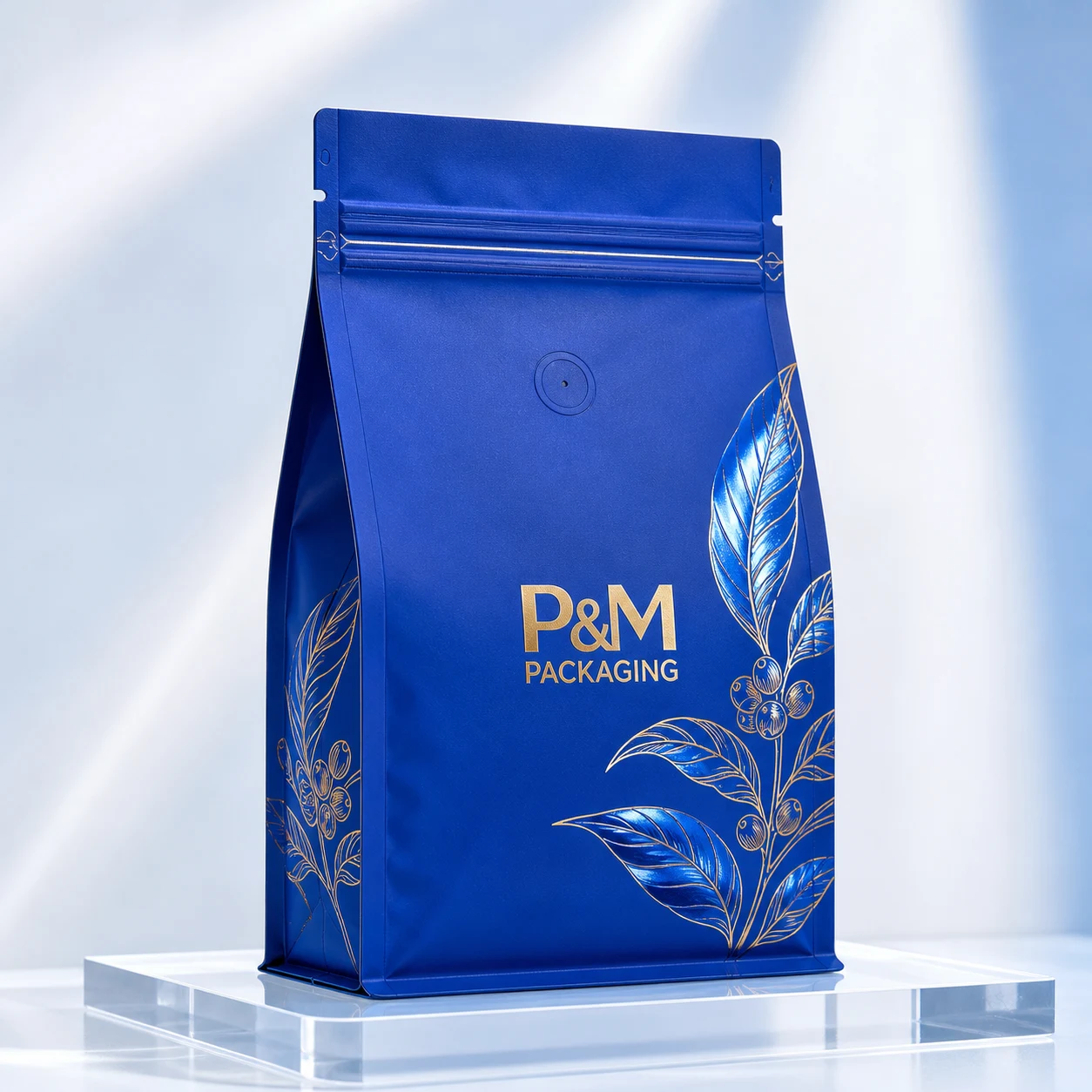
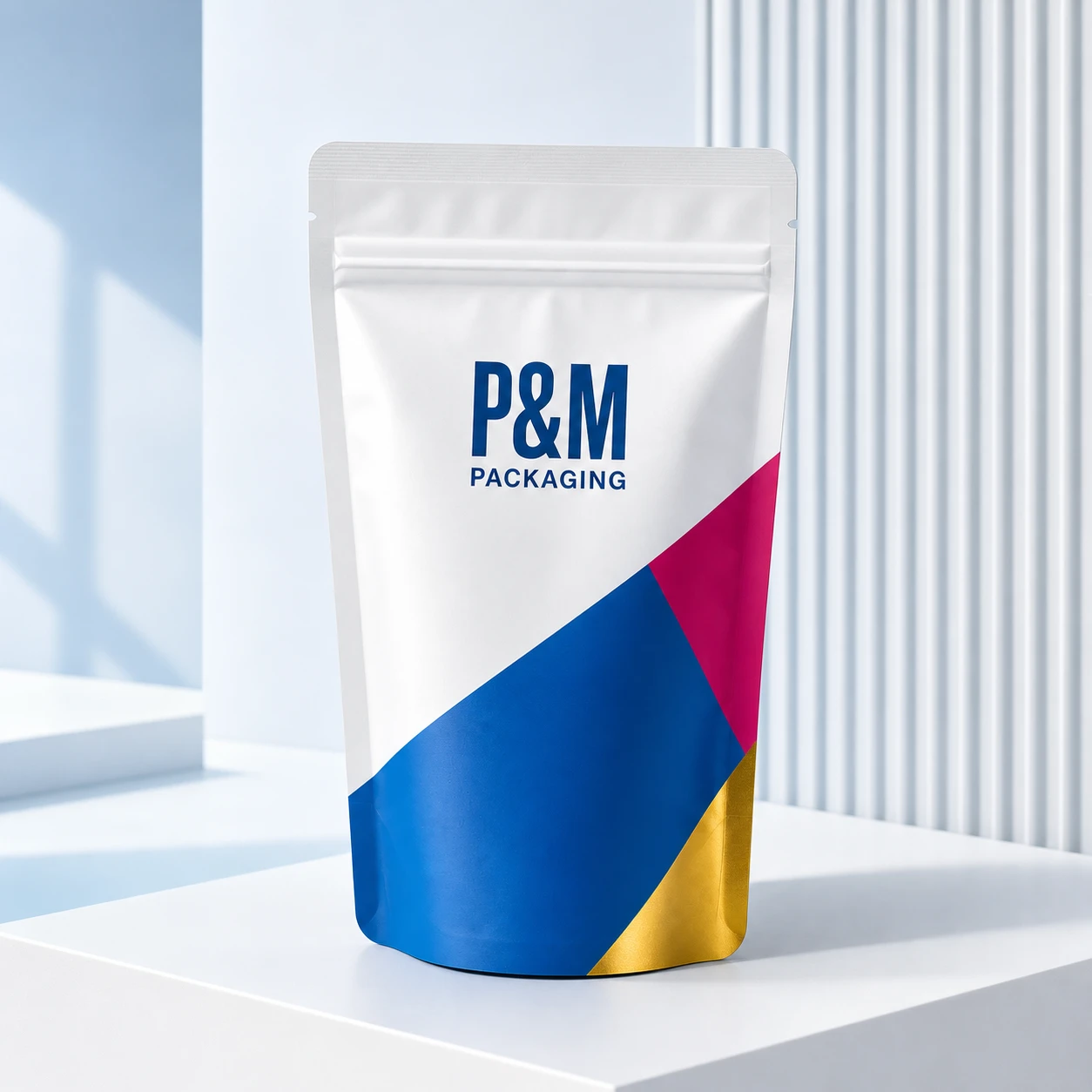
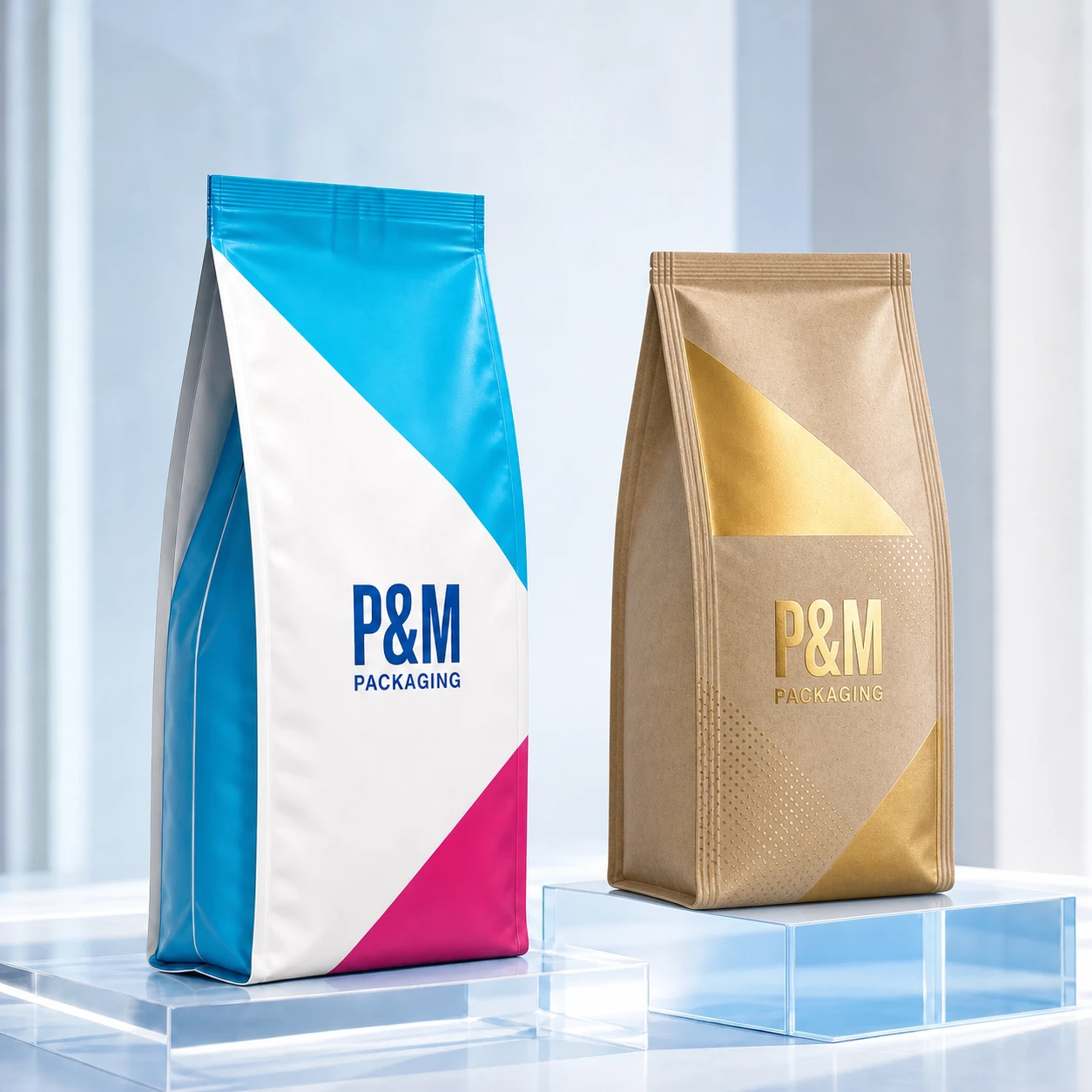
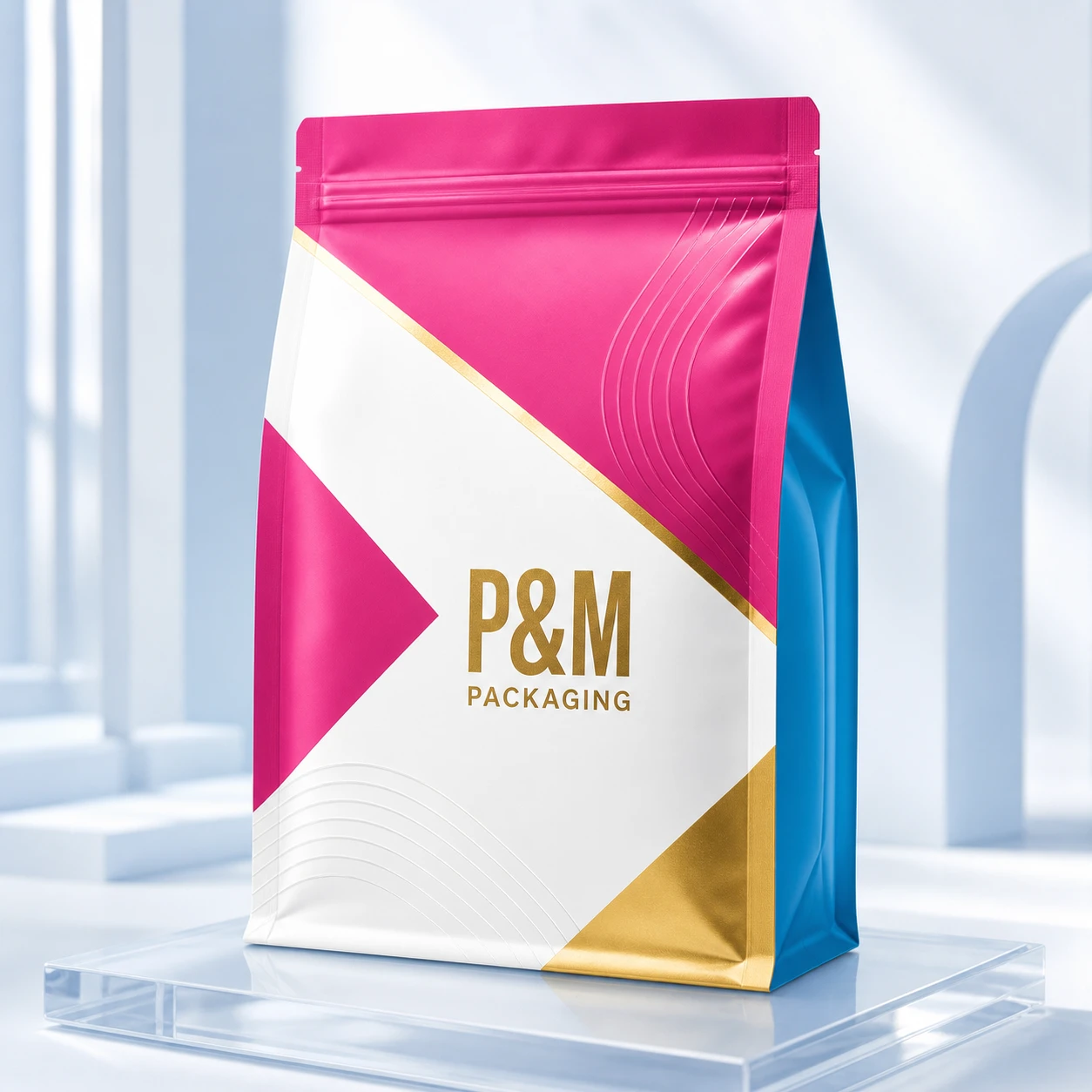
Flat-bottom, stand-up, side-gusset, and quad-seal coffee bags engineered around roast timing, aroma barrier, zipper, one-way degassing valve, artwork, and order stage. The general production baseline starts from 100 pieces per SKU; the exact minimum is confirmed for the approved specification and production route.
P&M develops custom printed coffee bags and wholesale coffee pouch programs for whole-bean, ground, and drip coffee. The specification connects bag format and fill weight with oxygen, moisture, aroma and light protection; optional valve and zipper; filling and final sealing; print and finish; quantity by SKU; destination; and target shelf life. A paid custom sample can start from 1 piece, and the general production baseline starts from 100 pieces per SKU. Process-specific minimums and plate or cylinder charges are confirmed in the quotation.
Custom coffee bags should fit the current launch without blocking the next production step. Choose the closest stage; the final MOQ depends on format, size, structure, artwork, and finish.
A one-way degassing valve cannot correct a weak barrier, poor seals, the wrong headspace, or unsuitable packing timing. We coordinate these decisions as one coffee packaging specification.
Finish feasibility, contrast, registration, scuff resistance, and appearance are approved on the selected structure and artwork.
Comparing suppliers?
Ask for a usable specification—not a bag description.
For custom coffee bags wholesale orders—or when comparing a coffee bag manufacturer or supplier—request the exact format, dimensions, laminate, valve, zipper, print route, tolerances, testing plan, MOQ by SKU, lead time, and approval controls.
View coffee materials, MOQ, and project controls Technical details
Material pathways
Match protection and claims to the complete coffee bag.
Available development paths may include high-barrier metallized or foil structures, kraft-faced laminates, reduced-plastic concepts, mono-material options, and qualified compostable or plastic-free paper systems. Every claim depends on the complete structure, accessories, evidence, target market, and finished-package performance.
Plan quantity by size, artwork, and production stage.
The general production baseline starts from 100 pieces per SKU. The exact minimum depends on bag format, dimensions, material structure, printing route, artwork count, valve or zipper, finish, and converting setup. Digital and offset routes can avoid conventional plate fees for qualified projects; rotogravure plate fees and process-specific minimums are confirmed in the quotation.
Confirm the filled package before repeat production.
Review the dieline, artwork zones, valve and zipper position, fill line, product fit, top seal, material evidence, finish appearance, samples or trials, case packing, and delivery requirements appropriate to the project.
Flat-bottom bags are currently the most requested format for many specialty coffee programs. Stand-up, quad-seal, side-gusset, and three-side-seal bags provide different advantages in filling, capacity, presentation, and cost. Product-fit and filling trials should confirm the dimensions rather than relying only on a nominal coffee weight.
Custom coffee bags are premade flexible packages printed and converted to specified dimensions, format, material structure, valve, closure, seals, and finish for whole-bean or ground coffee. A coffee bag specification connects the roast and packing timing, fill weight and bulk density, oxygen and moisture barrier, degassing behavior, opening and reclosure, filling method, storage, distribution, artwork, quantity, and shelf-life target.
Custom printed whole-bean coffee bags
Ground coffee packaging bags
Retail, sample, subscription, and foodservice sizes
Premade bags for compatible filling and final sealing
Digital, flexographic, or gravure print routes by project
Choose the material path around the coffee and market
Start with whole-bean, ground, or drip coffee; target shelf life; OTR and WVTR requirements; filling method; valve and zipper; and destination market. White or natural kraft, tissue, or glassine can provide the paper face while the remaining layers establish barrier and heat sealing. Raw-material reports and compostability certificates are available, but a finished-package claim must cover the complete structure, inks, adhesive, zipper, valve, and intended market.
Conventional High-Barrier Kraft
Kraft / VMPET / PE, with aluminum foil or AlOx PET available when stronger barrier is required. Prioritize freshness, converting reliability, and print performance.
Reduced-Plastic Kraft
Optimize layer count, thickness, or structure to reduce conventional plastic while retaining the functions required by the coffee. Any reduction claim is calculated for the final specification.
Industrially Compostable Pathway
Kraft / PLA or VMPLA / PBAT structures with PLA or industrially compostable zipper and degassing-valve options. Claims depend on complete-package evidence.
Home-Compostable Pathway
Kraft / VMNK / PBS for higher barrier, or a reduced structure when barrier is not required. Material grade, components, and certification scope must support the final wording.
Plastic-Free Paper Pathway
Kraft / NK or Kraft / VMNK / NK options evaluated around barrier, heat sealing, adhesive, ink, accessories, and destination-market definitions before a claim is approved.
Does a coffee bag need a degassing valve?
Not every coffee bag needs a valve. The decision depends on roast level, elapsed time between roasting and packing, gas release, whole-bean or ground product, package size, headspace, distribution, shelf-life target, and packing process. When used, the valve material, flow behavior, opening pressure, position, insertion method, seal interface, and final bag performance must be confirmed together.
One-way degassing valve type and supplier
Valve position relative to fill line and artwork
Packing timing after roasting
Whole-bean or ground coffee behavior
Headspace, bag size, and expected gas release
Leak, seal, transport, and shelf-life validation
Plan zipper, tin tie, opening, and reclosure
Press-to-close zippers, pocket-style concepts, tin ties, tear notches, and laser-scored openings affect the usable opening, fill line, top seal, consumer access, repeated use, and production sequence. Reclosure can help protect coffee after opening, but it does not replace the original barrier and seals.
Choose a format-specific reference size, then confirm product fit
Common coffee weights such as 8 oz, 12 oz, 16 oz or 1 lb have established reference dimensions for stand-up, flat-bottom, side-gusset and other bag formats, including portrait and landscape layouts. Use the applicable format drawing as the starting point, then confirm the intended coffee, headspace, valve, zipper, material and filling method before production.
8 oz stand-up pouch reference: 125 × 200 + 70 mm
12 oz stand-up pouch reference: 145 × 220 + 80 mm
12 oz flat-bottom reference: 150 × 250 + 50 + 50 mm
12 oz side-gusset reference: 110 × 290 + 60 mm
16 oz / 1 lb stand-up pouch reference: 155 × 230 + 85 mm
16 oz / 1 lb flat-bottom reference: 170 × 280 + 50 + 50 mm
16 oz / 1 lb side-gusset reference: 120 × 320 + 65 mm
Physical fill check and customer artwork approval before production
Build the print plan around SKUs and order stage
The general production baseline starts from 100 pieces per SKU, but every size and artwork must be listed separately because the exact minimum depends on the bag format, dimensions, material structure, print route, valve or zipper, finish, and converting setup. A shared bag with controlled SKU labels may reduce inventory risk for qualified programs, while fully printed SKU designs can be evaluated against repeat demand and total program cost. Digital and offset routes can avoid conventional plate fees for qualified projects; rotogravure plate fees and any finishing tooling are confirmed in the quotation.
Information needed to quote custom coffee bags
Provide the coffee type and roast condition, whole-bean or ground product, target fill weight, desired format and approximate dimensions, valve and closure needs, barrier or shelf-life target, filling and sealing method, print and finish, quantity for each size and artwork, samples or testing needed, destination, and timing. Existing bags, photos, dielines, artwork, or filling-equipment details help define the review.
Packaging Knowledge Center
Professional guides for this application
Use these practical articles to prepare specifications, identify project risks, and ask better questions before sampling or production.
There is no single best structure for every coffee. Select materials around oxygen, moisture, aroma, light, oils, roast and packing timing, valve and zipper compatibility, filling, distribution, and shelf-life target. Metallized, foil, clear, kraft-faced, and mono-material pathways have different performance and evidence requirements.
Does every coffee bag need a degassing valve?
No. Valve need depends on the coffee, roast level, packing timing, gas release, whole-bean or ground product, package size, headspace, distribution, and shelf-life target. If a valve is used, its type, position, insertion, and bag interface must be validated.
What is the difference between whole-bean and ground coffee packaging?
Whole-bean and ground coffee differ in bulk density, gas release, aroma exposure, product flow, dust, and usable volume. These differences can change bag dimensions, headspace, valve decisions, filling, seals, and shelf-life validation even at the same labeled net weight.
View 4 more questions
Are coffee bags recyclable or compostable?
Some structures may support a recyclable or compostable pathway, but the claim must be based on the exact films, paper, coatings, adhesives, inks, zipper, valve, and other components, plus applicable test or certification scope and the recovery system in the target market. Conventional multilayer coffee bags should not be assumed recyclable.
What sizes are available for custom coffee bags?
Coffee bags have established engineering reference sizes by net weight, bag format and portrait or landscape layout. Examples include 125 × 200 + 70 mm for an 8 oz stand-up pouch, 150 × 250 + 50 + 50 mm for a 12 oz flat-bottom bag, and 170 × 280 + 50 + 50 mm for a 16 oz / 1 lb flat-bottom bag. Final production dimensions are confirmed with the intended whole-bean or ground coffee, headspace, valve, zipper, material, filling method and physical fill check.
What is the MOQ for custom printed coffee bags?
The general production baseline starts from 100 pieces per SKU, while a paid custom sample can start from 1 piece. The exact production MOQ depends on bag dimensions, material structure, print route, quantity per artwork, valve or zipper, finish, lamination, and converting setup. Confirm every size and SKU in the quotation.
How do printing plate and cylinder fees work for coffee bags?
Qualified digital and offset projects do not require conventional gravure cylinders, so conventional plate fees do not apply. Rotogravure plate or cylinder fees can depend on format, dimensions, color count, quantity, and the quoted production route. Finishing tools are also specification dependent and should be listed in the quotation.
Start with the product and project stage.
Share the format, expected quantity, and what the package needs to do. We’ll organize the next decisions.
 WhatsApp