Direct answer
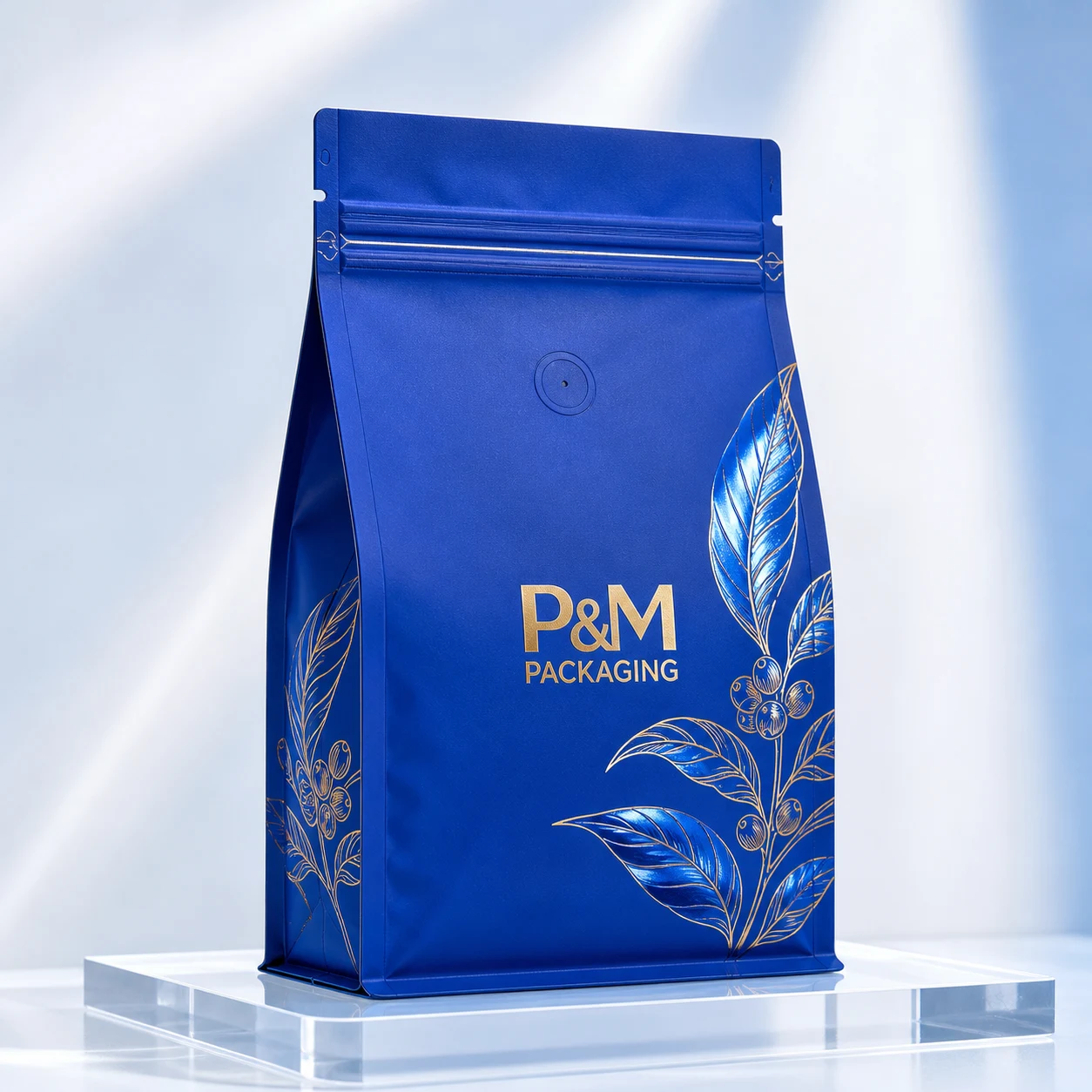
Flat-bottom coffee bags use a defined base and five printable panels to create strong shelf stability and brand area. Common starting points include 8 oz, 12 oz, 16 oz, and 1 lb formats, but final dimensions must be confirmed with the actual whole-bean or ground coffee, bulk density, headspace, zipper, one-way degassing valve, material structure, filling method, and case pack. Premium options can include soft touch, selective gloss or Spot UV, hot or cold foil, embossing, opaque white, and interior printing.
Why specialty coffee brands choose flat-bottom bags
A flat-bottom coffee bag forms a defined rectangular base with front, back, two side panels, and a bottom panel. The format can stand securely on shelf and provides broad surfaces for origin, roast, brewing, sustainability, and brand information.
The same geometry also affects filling clearance, usable volume, case count, pallet pattern, zipper access, and cost. Choose it when the shelf stance and five-panel artwork justify the converted-bag structure, not only because it is currently popular.
Start with 8 oz, 12 oz, 16 oz, or 1 lb—then run a fill check
Nominal coffee weights are useful search and sourcing references, but one 12 oz flat-bottom bag does not fit every 12 oz coffee. Whole-bean and ground coffee differ in bulk density, roast development, particle behavior, gas release, and headspace needs.
A common 12 oz flat-bottom reference is approximately 150 × 250 + 50 + 50 mm, while a 16 oz or 1 lb reference may begin near 170 × 280 + 50 + 50 mm. These are finished outside dimensions, not automatic production specifications. Confirm product fit, fill line, zipper access, top-seal area, valve position, and case pack with the intended coffee.
- Coffee form and roast condition
- Target net weight and bulk density
- Required headspace
- Filling and final-seal method
- Zipper, valve, and tear opening
- Filled-bag and case-pack check
Coordinate the one-way degassing valve with the complete bag
A one-way valve releases internal pressure as roasted coffee emits carbon dioxide while limiting oxygen entry through the valve path. Valve need depends on roast level, elapsed time between roasting and packing, whole-bean or ground product, package size, distribution, and shelf-life target.
Position the valve above the expected product line and away from the zipper, top seal, critical artwork, filling grippers, folds, and high-contact case areas. The valve type, opening behavior, insertion method, laminate interface, leak performance, and finished-bag trials should be approved together.
Choose barrier materials around freshness—not appearance alone
Coffee protection can require control of oxygen, moisture, aroma transmission, light, oils, seals, and package integrity. Metallized PET, aluminum foil, coated or transparent high-barrier films, kraft-faced laminates, and mono-material pathways offer different performance, cost, appearance, and evidence profiles.
A natural paper face does not establish that the complete coffee bag is recyclable, compostable, biodegradable, or plastic-free. Review the exact films or papers, coatings, adhesives, inks, zipper, valve, labels, certification scope, target market, and finished-package performance before approving a claim.
Use soft touch, Spot UV, foil, and embossing with a clear hierarchy
Premium coffee bags are strongest when each finish has one job. Soft touch or a controlled matte surface can set the base feel; selective gloss or Spot UV can reveal a pattern; hot or cold foil can highlight the logo; embossing can create one tactile focal point; and opaque white can control contrast on natural or black kraft.
Keep fine legal copy, seals, zipper tracks, valve zones, folds, and high-rub areas out of unsuitable finish layers. Approve metallic reflection, gloss contrast, color, registration, scuff resistance, and tactile effect on the selected material rather than relying only on a screen mockup.
What to send for a flat-bottom coffee bag quote
Provide the coffee type and roast condition, whole-bean or ground form, target fill weight, current or desired dimensions, zipper and valve needs, shelf-life or barrier target, filling method, artwork status, finishes, quantity for each size and SKU, delivery destination, and target date.
A current filled bag, reference photo, dieline, artwork, or shipping-case requirement can shorten the first review. If those are not ready, begin with the product, fill weight, quantity, and commercial stage so the specification can be developed in the right order.
General educational information only. Materials, performance, compliance, claims, quantities, and timing require confirmation for the exact packaging project.