 WhatsApp
Application scenario · Not a customer case study
Food packaging
Custom Flexible Food Packaging Bags & Rollstock
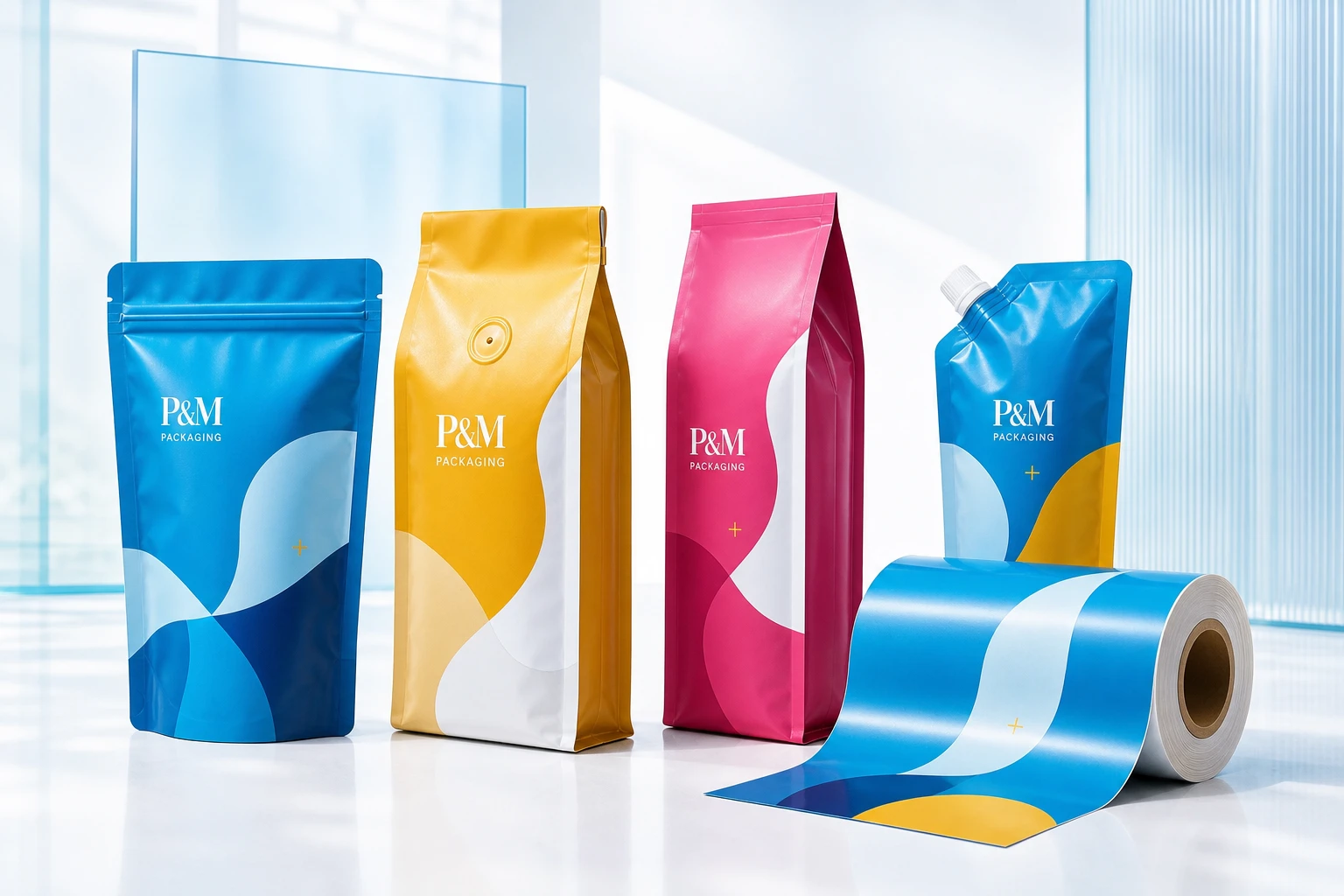
Source custom empty flexible food packaging components for a defined brand or co-packer project. P&M develops premade pouches and printed rollstock around the exact food, fill weight, filling process, storage, distribution, target shelf life, quantity by SKU, artwork, and required approval work.
Direct answer
P&M supplies custom empty flexible packaging components for U.S. food brands, procurement teams, and co-packers. Choose premade pouches when converted bags fit the filling route, or printed rollstock when the approved packing equipment forms and seals the package. Final food-contact, barrier, seal, shelf-life, and line suitability depend on the exact food, structure, filling conditions, storage, distribution, and project validation.
Start with your need
What needs to happen next?
No finished specification required. Send a product or reference photo on WhatsApp.
Premade Food Pouches & Bags
Stand-up, flat-bottom, side-gusset, quad-seal, three-side-seal, shaped, and other qualified bag formats reviewed around the exact food and filling route.
Compare custom pouch formats →Printed Food Packaging Rollstock
Printed film specified from the co-packer or filling-line requirements, including web, repeat, unwind, seals, coding, and trial conditions.
Review printed rollstock →Flat-Bottom Food Bags
A dedicated owner for stable five-panel bags where fill volume, shelf stance, closure, barrier, and packing route support the format.
Explore flat-bottom bags →Shrink Sleeve Label Review
If a food buyer requests a sleeve-label project, route the request to the dedicated owner with the final container and application details. Industry context alone does not confirm availability.
Review the shrink sleeve label process →Food flexible-packaging project path
Choose the package owner before specifying the material.
Start with the food, fill weight, filling route, storage, distribution, target shelf life, and quantities by SKU. P&M then routes the project to premade pouches, printed rollstock, or a dedicated application owner without treating every food package as the same system.
Discuss this applicationSend the product, format, quantity, and current challenge.
View the complete packaging system and approval inputs
Premade route
Custom food pouches and bags
Use converted bags when the approved filler can load and final-seal the selected format. Confirm opening, fill level, seals, closure, barrier, pack-out, and validation.
Explore format Machine-web routePrinted food packaging rollstock
Use rollstock when the approved equipment forms and seals the package. Confirm the machine specification, web, repeat, unwind, registration, core, roll diameter, seal window, and trials.
Explore format Application routeDedicated food-industry owners
For snacks, frozen foods, sauces, jerky, powders, coffee, or pet food, use the dedicated page where product behavior creates a more specific buyer task.
Explore formatWhat to bring
Inputs for the first packaging review
- Food type, ingredients, oils and aroma
- Fill weight and filling equipment
- Processing and storage temperature
- Shelf-life and barrier targets
- Retail, ecommerce and distribution route
- Quantities by SKU and target timing
What to confirm
Verification before production
- Food-contact documentation for the final structure
- Seal, leak or package-integrity plan
- Shelf-life and compatibility work as applicable
- Artwork panels, coding and responsible label approval
- Filled-package distribution testing where required
What this food-packaging page covers
This page covers custom empty premade pouches and printed rollstock supplied to food brands, procurement teams, and co-packers. P&M does not supply filled food, formulate the product, provide co-packing or filling machinery, or sell stock grocery, takeaway, paper, or consumer-storage bags for immediate retail use.
- Exact food and fill weight
- Premade-pouch or rollstock route
- Filling or co-packer requirements
- Storage, distribution, and target shelf life
- Quantity by SKU, artwork, and timing
Choose premade food bags or printed food rollstock
Premade pouches arrive converted for a compatible filling and final-sealing process. Printed rollstock is specified from the approved packing-line requirements and formed and sealed by that equipment. Product behavior, package style, filler or co-packer capability, SKU count, order volume, seals, coding, and line trials determine the practical route.
Premade Food Pouches & Bags
Stand-up, flat-bottom, side-gusset, quad-seal, three-side-seal, shaped, or spouted formats may be reviewed for the exact product and filling route.
Compare premade pouch formats →Food Packaging Rollstock
Printed web developed from the co-packer or equipment specification, including web width, repeat, unwind, core, roll diameter, registration, seal window, and trial requirements.
Review food rollstock →Sachets & Stick Packs
Small-format single-serve concepts coordinated around dose, lanes, film, seals, tear, coding, filling equipment, and multipack needs.
Explore sachets and stick packs →What to send for a useful food-packaging quote
Send the exact food, relevant product characteristics, fill weight, desired format, existing dimensions or reference package, filling or co-packer requirements, processing and storage conditions, target shelf life, distribution route, quantities by SKU, artwork status, destination, and target timing. General custom finished-bag production can start from 100 pieces per SKU; rollstock, fitments, retort, and other process-specific minimums are quoted separately. A one-piece paid custom sample is a separate development step and is not proof of food compatibility, line performance, or finished-package validation.
View more technical specifications 8 sections
Food packaging bags by format
Bag format controls shelf stance, printable panels, opening, reclosure, usable volume, filling access, pack-out, and equipment route. It does not determine barrier or food suitability by itself.
Stand-Up Pouches & Bags
Bottom-gusset bags for snacks, candy, powders, coffee, tea, pet treats, and other reviewed foods, with optional zipper, window, valve, spout, and tear features.
Explore stand-up food pouches →Flat-Bottom / Box Bags
Five-panel bags for stable presentation, large printable areas, reclosure, valve, and premium food or coffee programs.
Explore flat-bottom food bags →Side-Gusset & Quad-Seal Bags
Expandable and structured formats for coffee, grains, dry foods, ingredients, pet food, and larger fill weights.
Explore gusseted food bags →Three-Side-Seal & Shaped Pouches
Flat, sample, portion, specialty, and custom-shaped formats reviewed around product fit, opening, seals, display, and packing method.
Explore flat food pouches →Spouted Food Pouches
Corner or top spout systems for suitable sauces, purees, beverages, refills, and liquid foods, coordinated with filling, cap, weld, seals, and leak control.
Explore spouted food pouches →Retort Food Pouches & Bags
Hermetic flexible packages for a validated post-fill thermal process, developed with the food, process authority, materials, seals, filling, cycle, cooling, testing, and applicable requirements.
Explore retort food packaging →Food packaging by product application
Each food category has a different combination of barrier, temperature, product-contact, filling, seal-contamination, opening, reclosure, protection, and distribution risks. Use the dedicated application page where available.
Dry Rice & Pasta Packaging Bags
Review custom premade bags and pouches for dry rice or dry pasta around the fill weight, bulk density, product edges, moisture control, opening, seals, and packing method. Specify the actual product and distribution conditions; vacuum, thermal processing, fresh-food use, and heavy-load performance need their own project qualification.
Compare premade pouch formats →Snacks, Chips, Nuts & Dried Fruit
Coordinate oils, aroma, moisture, product drop, crumbs, puncture, reclosure, rollstock, case pack, and shelf presentation.
Explore snack packaging →Candy, Gummies & Chocolate
Review heat sensitivity, grease, scuffing, portioning, flow-wrap or pouch format, cartons, displays, and distribution.
Explore candy packaging →Frozen Foods
Plan low-temperature film behavior, puncture, moisture, seals, coding, handling, storage, cases, and filled-package testing.
Explore frozen food packaging →Jerky & Dried Meat Snacks
Coordinate oxygen and moisture control, oils, headspace, zipper, seals, shelf-life validation, and distribution.
Explore jerky packaging →Powders, Spices & Ingredients
Account for bulk density, flow, dust in seals, moisture sensitivity, dose, scoop access, zipper, sachet or stick-pack equipment, and coding.
Explore powder packaging →Sauces, Condiments & Liquid Foods
Review viscosity, particles, fill temperature, sachet or spout route, dispensing, welds, seals, leaks, secondary packaging, and handling.
Explore sauce packaging →Coffee & Tea
Coordinate aroma and oxygen protection, moisture, degassing where required, zipper or tin tie, filling, formats, paper options, and brand finish.
Explore coffee bags →Pet Food & Treats
Plan grease and aroma control, puncture, larger fill weights, zipper durability, handles, filling, palletization, samples, and rollstock.
Explore pet food packaging →Barrier, seals, and consumer use
Oxygen, moisture, light, aroma, grease, puncture, product edges, temperature, headspace, opening, reclosure, and expected shelf life guide the complete package. A high-barrier film alone does not establish suitability for the finished food package.
Printing, coding, and required information
Artwork should reserve appropriate areas for product identity, net quantity, ingredients, nutrition or other applicable information, warnings, lot or date coding, and business details. The responsible food company must approve final labels and claims.
If a food buyer asks about a sleeve-label project
Route the request to the dedicated shrink sleeve label owner, but do not treat the food application as a confirmed P&M capability. The responsible supplier must confirm availability and the proposed specification in writing for the final container and application.
From samples to production and delivery
The path can include format samples, sizing review, material and structure confirmation, artwork and dielines, prepress proofing, filled-package trials, approved specifications, production, quality checks, and delivery planning. Exact steps depend on the package and food process.
Choose a focused food-packaging application
Use a dedicated application path when product behavior, processing, serving, or distribution creates more specific packaging decisions.
- Frozen foods: low-temperature flexibility, moisture, seals, cartons, and cases
- Snacks and candy: aroma, grease, product protection, portions, reclosure, displays, and rollstock
- Sauces: viscosity, particles, sachets, spouts, filling, leak testing, and secondary pack-out
- Jerky: oxygen and moisture control, headspace, seals, zipper, shelf life, and distribution
- Powders: bulk density, dust, dose, seal contamination, barrier, scoop access, and reclosure
Move the food project through controlled approvals
Start with a project brief, confirm the filler or co-packer specification, approve product-fit samples, establish performance and test responsibilities, release the dieline, preflight each SKU, and retain an approved specification, artwork revision, proof or color target, and production-release record.
Packaging Knowledge Center
Professional guides for this application
Use these practical articles to prepare specifications, identify project risks, and ask better questions before sampling or production.
View 11 more related guides
Problem-Solving GuideWhy Food Pouches Leak—and How to Prevent It→Freshness Problem-SolvingWhy Packaged Foods Lose Freshness Before the Quality Date→Film Structure GuideFlexible Packaging Materials and Film Structures→Thermal Process ComparisonHot-Fill Pouches vs Retort Pouches→Food Pouch PackagingHow to Choose Food Pouch Packaging→Barrier Materials GuideHow to Specify High-Barrier Pouch Materials→Package Testing GuideHow to Test Pouch Seal Integrity and Leaks→Shrink Sleeve Buyer GuideHow to Specify Custom Shrink Sleeve Labels→Food Packaging GuideHow to Choose a Custom Pouch Format→Packaging SourcingCustom Packaging RFQ Checklist→Project ToolPackaging Project Brief Template→
Frequently asked questions
What information is needed to quote custom food packaging?
Provide the food, fill weight, packaging format, dimensions or reference, filling and processing method, storage, shelf-life goal, barrier or closure needs, quantities by SKU, artwork status, destination, and target timing.
Should I use premade food pouches or printed rollstock?
Use the format supported by the filling route and commercial plan. Premade pouches arrive already converted and run on premade-pouch equipment; rollstock is formed, filled, and sealed on VFFS, HFFS, flow-wrap, sachet, stick-pack, or related equipment. Product behavior, package style, speed, seals, coding, SKU count, quantity, co-packer capability, and trial results guide the choice.
What types of custom food packaging bags are available?
Reviewed formats include stand-up, flat-bottom, side-gusset, quad-seal, three-side-seal, shaped, spouted, retort, and other application-specific bags and pouches. The correct format depends on food, fill quantity, barrier, filling, opening, reclosure, temperature, shelf use, distribution, and order plan.
View 4 more questions
Can food bags include zippers, windows, valves, spouts, or handles?
Potentially. Press-to-close or other zippers, clear windows, one-way valves, spouts and caps, tear features, hang holes, and handles must be coordinated with the food, bag format, structure, seals, fill opening, equipment, product-contact scope, performance, testing, and claim requirements.
Does P&M provide filled food or co-packing?
No. P&M supplies custom empty packaging components. The food brand or co-packer remains responsible for formulation, filling, processing, finished-package validation, labeling, and market approvals.
Does a food-grade film approve the finished package?
No. Food-contact status is specific to the final material and conditions of use. The complete structure, inks, adhesives, closures, filling, processing, seals, food, storage, and applicable documentation must be reviewed.
How should a food brand request a shrink sleeve label review?
Use the dedicated shrink sleeve label path and provide the final container, closure, desired coverage, artwork status, application method, quantities, destination, timing, and approval needs. Food-industry context alone does not confirm P&M availability; the responsible supplier must confirm the offered specification in writing for the exact project.