Direct answer
Select flexible packaging materials by translating the product and process into measurable requirements for product contact, oxygen and moisture barrier, aroma and light protection, puncture, stiffness, sealing, temperature, filling equipment, storage, distribution, opening, shelf life, and end-of-life claims. PET/PE, BOPP/CPP, PA/PE, EVOH-containing films, metallized laminates, aluminum-foil laminates, PE- or PP-family mono-material structures, and paper-faced laminates are different construction pathways—not universal recipes. Confirm the exact layer order, grades, thicknesses, adhesives or tie layers, conditions of use, and finished-package validation for each project.
How to read a flexible packaging film structure
A flexible packaging structure is usually written from the outside print surface toward the inside product-contact and sealing surface, but every specification should state its convention. A notation such as PET/PE names polymer families, not the film grades, thicknesses, treatments, inks, adhesive, barrier coating or sealant performance needed to reproduce the package.
The outside layer may support printing, stiffness, heat resistance and abrasion. Middle layers can add barrier, opacity, puncture or structure. The inside layer provides product contact and sealing. Adhesives, tie layers, primers, coatings, inks, metallization, white layers and surface treatments are also part of the construction.
- Layer order and orientation
- Material grade and supplier
- Thickness of every layer
- Ink, coating, primer and adhesive system
- Barrier or metallized layer
- Product-contact and sealant layer
- Total thickness and tolerances
PET/PE laminated packaging film
A PET/PE structure commonly combines an oriented polyethylene terephthalate outer web with a polyethylene-family sealant. PET can provide print quality, dimensional stability, stiffness and resistance to converting heat, while PE can provide toughness and a practical heat-seal layer. Grades and additional layers determine the actual barrier and performance.
PET/PE packaging may be reviewed for many dry, frozen, liquid, refill and general pouch applications, but the two material names do not establish product compatibility, puncture resistance, oxygen barrier, hot-fill suitability, freezing performance or shelf life. Metallization, coatings, PA, EVOH or other layers may be added where justified.
BOPP/CPP flexible packaging film
BOPP is biaxially oriented polypropylene and CPP is cast polypropylene. A BOPP/CPP laminate can combine a printable, clear or treated oriented outer web with a polypropylene-family sealant. It is often reviewed for snacks, confectionery, dry foods and other applications where appearance, stiffness, moisture resistance and sealing behavior fit the product and equipment.
BOPP and CPP exist in many grades, including white, matte, metallized, high-barrier, retort-oriented and specialty sealing films. Do not infer temperature range, oxygen barrier, grease performance or recyclability from the abbreviations alone. Confirm the complete structure, adhesive, conditions of use, sealing window and recovery pathway.
PA/PE and PET/PA/PE structures
PA, or polyamide, is commonly called nylon in packaging discussions. PA/PE and PET/PA/PE constructions may be considered when puncture resistance, toughness, flex durability or product-edge protection is important. Applications can include selected frozen foods, vacuum packages, liquids, meat or seafood products, pet food and heavier fills.
Polyamide can absorb moisture and its properties depend on grade, conditioning and surrounding layers. It is not automatically a high oxygen- or moisture-barrier solution for every environment. Define puncture, flex, temperature, barrier, seal and distribution targets, then validate the actual laminate and filled package.
Metallized film and aluminum-foil laminates
Metallized film uses a very thin deposited metal layer—often on PET or BOPP—to improve light, oxygen, moisture and aroma protection while keeping material weight lower than a foil laminate. Performance depends on metal coverage, optical density, substrate, handling, lamination, flexing, pinholes, seals and package geometry.
Aluminum-foil packaging uses a discrete foil layer that can provide very strong gas, moisture, aroma and light barrier in a suitable laminate. Foil structures require attention to flex cracking, pinholes, folds, stiffness, sealing, metal detection, microwave restrictions, retort or process conditions and distribution damage. Neither metallized film nor foil alone proves finished-package shelf life.
- PET/metallized PET/PE concepts
- BOPP/metallized BOPP/CPP concepts
- PET/aluminum foil/PE concepts
- Paper/foil/sealant constructions
- Application-specific retort foil laminates
- Transparent-barrier alternatives where visibility matters
EVOH and transparent high-barrier films
EVOH, or ethylene vinyl alcohol, can provide strong oxygen barrier in a protected multilayer structure. It is commonly incorporated through coextrusion or another multilayer route and surrounded by layers that provide moisture protection, sealing, toughness and process compatibility.
EVOH performance can change with humidity, grade, thickness and processing. Transparent oxide-coated films and other barrier coatings may also support clear high-barrier packaging. Compare OTR and WVTR only at stated test conditions, then evaluate converting, flexing, seals, filling, storage and shelf life in the complete package.
PE/PE and PP/PP mono-material pathways
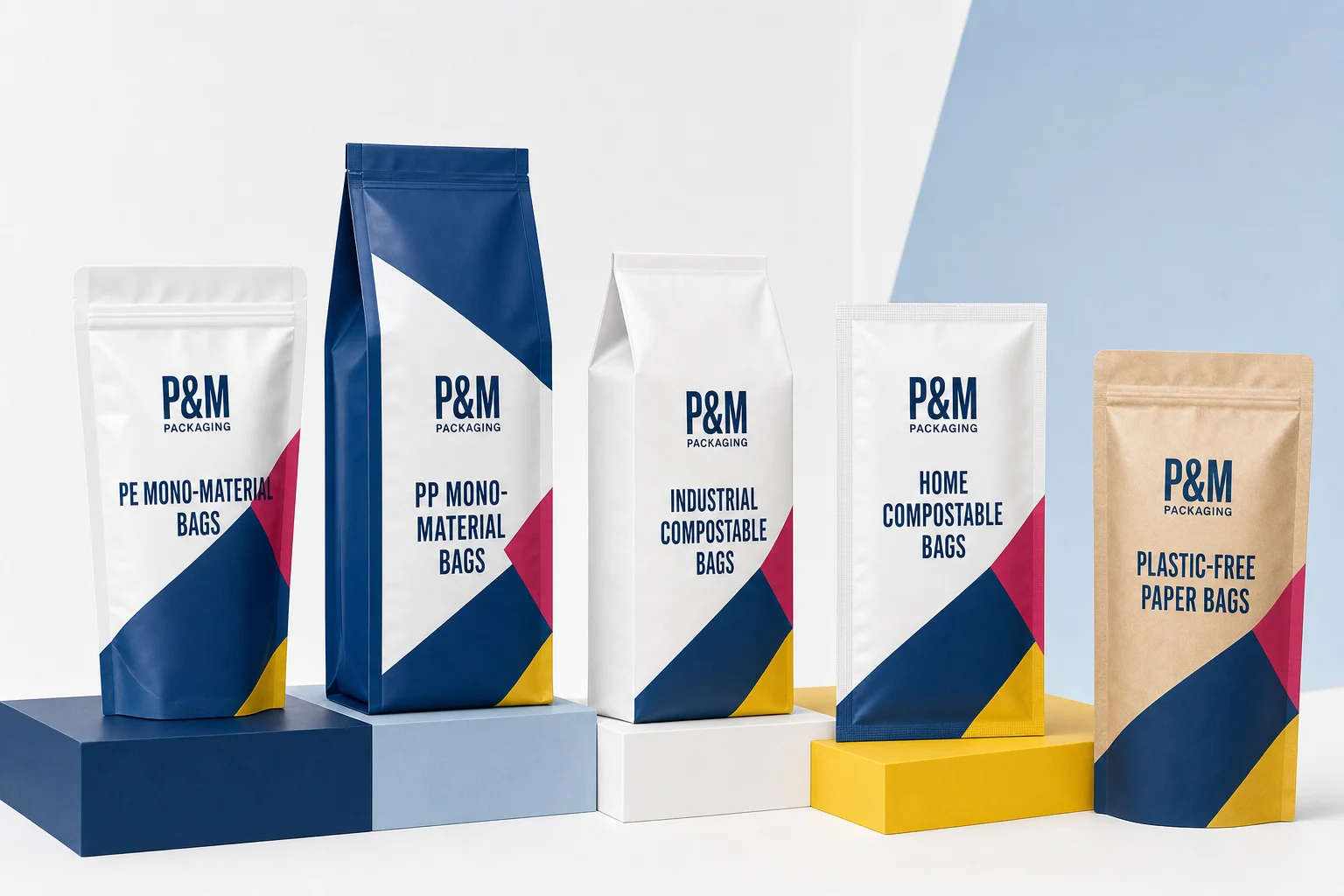
A PE-family mono-material structure can combine oriented, blown, machine-direction-oriented or specialty PE outer webs with PE sealants and compatible barrier components. A PP-family pathway can combine BOPP, CPP and related PP layers. These designs aim to keep the package predominantly within one polymer family while meeting print, stiffness, barrier, sealing and handling needs.
Mono-material packaging does not automatically mean recyclable in every location. Inks, coatings, adhesives, zippers, valves, spouts, barrier layers, labels and the package's size and color can affect compatibility with a recovery system. Use market-specific design guidance and evidence for the exact structure and claim.
Kraft paper and paper-faced laminates
Natural or white kraft paper can provide texture, stiffness, opacity and a paper-led appearance. Many heat-sealable kraft pouches are paper-faced laminates that include polymer sealants, barriers, adhesives, windows or other layers. The visual paper surface does not establish that the complete package is paper-only, recyclable, compostable or plastic-free.
Specify paper grade, source documentation where required, print surface, grease and moisture exposure, fold and crack behavior, barrier, inner sealant, window construction, closure, filling and storage. Environmental wording must match the exact bill of materials and applicable evidence.
Lamination, coextrusion, adhesives, and curing
Laminated packaging film bonds separately produced webs with an adhesive or extrusion layer. Coextruded film forms multiple polymer layers in one film-making operation. The chosen route affects layer combinations, thickness control, barrier placement, sealing, stiffness, print protection, lead time and economics.
Adhesive chemistry, mix and coat weight, web treatment, cure time, residual solvents or reactants, bond strength, tunneling, delamination, product interaction and processing temperature require controlled specifications. A layer list without the joining system is incomplete.
Match structures to filling and thermal conditions
Premade pouches, VFFS, HFFS, vacuum packaging, hot fill, freezing, pasteurization and retort impose different heat, tension, coefficient-of-friction, sealing, flex and pressure requirements. Share the machine, jaw type, line speed, fill temperature, final-seal method, cooling, storage and distribution conditions before selecting the material.
A film described as freezer, hot-fill or retort grade should be treated as a starting material designation. The complete product-package-process system, including inks, adhesives, seals, zipper, valve or fitment, must be reviewed and validated for the intended conditions.
Specify performance instead of copying a layer list
Two structures with the same abbreviations can perform differently because grades, thicknesses, barrier coatings, adhesive, treatment, converting, seals and suppliers differ. Begin with the failure modes and measurable needs: oxygen, moisture, aroma, light, grease, chemical compatibility, puncture, flexing, stiffness, seal window, hot tack, opening and distribution.
Where relevant, define OTR and WVTR with test conditions, seal-strength and leak methods, dimensional tolerances, coefficient of friction, bond strength, visual standards, migration or food-contact documentation, filling-line trials, distribution work and product shelf-life validation. Record the approved structure and change-control rules.
Flexible packaging materials RFQ checklist
A useful request explains what the package must protect and how it will be made, filled, stored, opened and disposed of. If an existing structure works, provide the specification, roll or bag labels, physical samples and available performance data rather than only a material abbreviation.
Provide the product and relevant formulation, fill weight, pouch or rollstock format, dimensions, equipment and filling method, processing temperature, target shelf life, storage and distribution, oxygen and moisture targets if known, light, aroma, grease, puncture and chemical needs, seal and closure requirements, environmental goals and market, quantity by artwork, documentation and testing responsibilities, delivery destination and target date.
General educational information only. Materials, performance, compliance, claims, quantities, and timing require confirmation for the exact packaging project.