Direct answer
Select a pouch spout and cap as part of the complete product-package-filling system. Define the product chemistry, viscosity and particles; required flow and dose; opening and flange dimensions; corner or top position; cap and tamper-evident design; resin compatibility; filling, welding and capping equipment; torque; seals; distribution; consumer use; and the tests required for the exact filled pouch.
What is a pouch fitment?
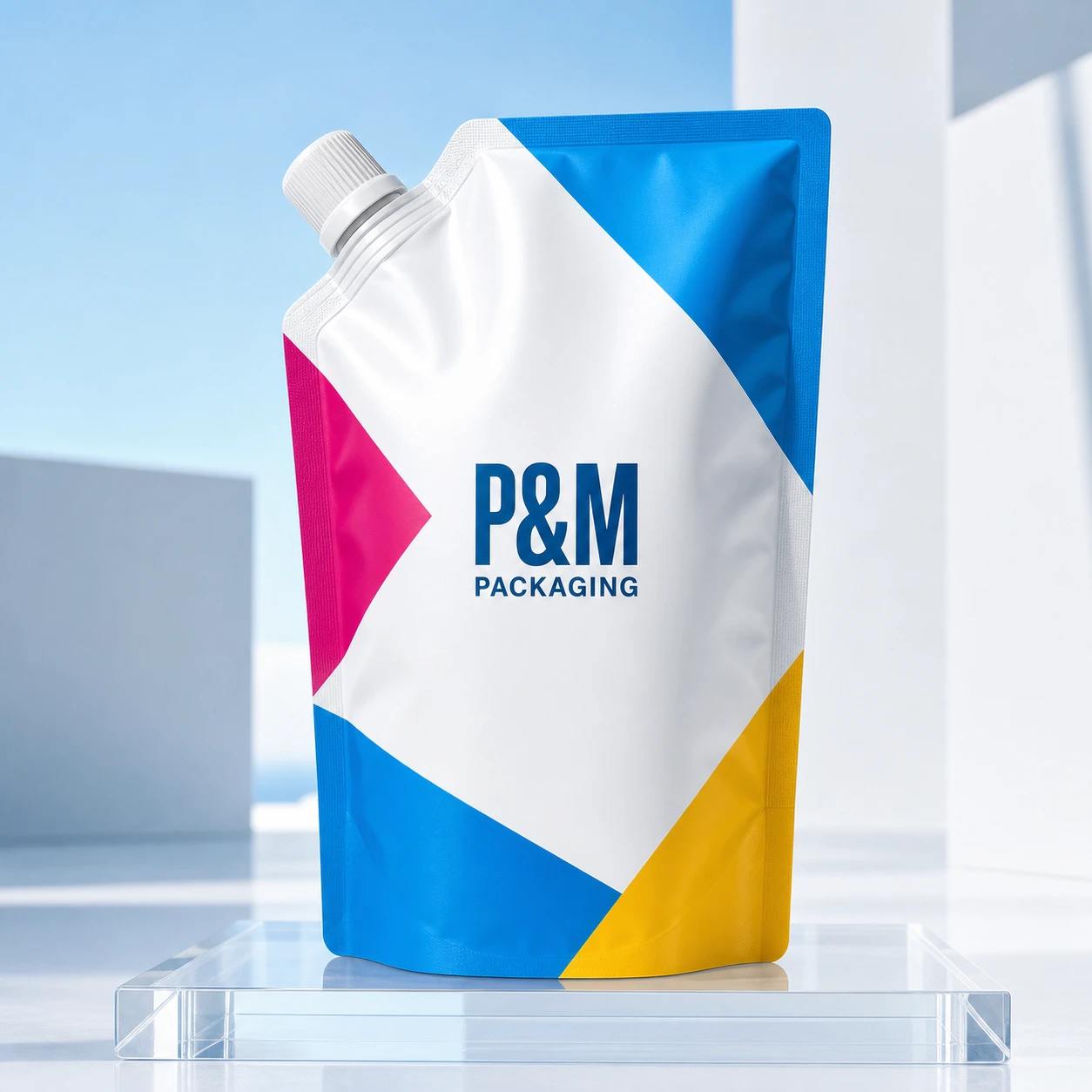
A pouch fitment is the rigid or semi-rigid dispensing component joined to the flexible bag. The assembly can include the spout body, internal bore, neck finish, weld flange, cap, tamper-evident element, liner, plug, valve or another application-specific part. These details are not interchangeable simply because two components look alike.
The fitment, laminate, sealant, weld process, filling equipment and cap must be developed as one interface. A catalog spout should not be approved from its outside appearance or a nominal diameter alone.
Let viscosity, particles and dose define the flow path
Start with the actual product: relevant chemistry, viscosity across the expected temperature range, particle or fiber size, tendency to foam, target dose, pour or squeeze behavior and whether the package will be used once or repeatedly. A thin beverage, concentrated cleaner, puree and sauce can require different flow paths even at the same fill volume.
A larger bore may improve flow for a thick or particulate product, but it can also affect dose control, cap size, flange footprint, pouch geometry, headspace, cost and filling equipment. Product trials are more reliable than a universal diameter chart.
- Product chemistry and compatibility data
- Viscosity at filling, storage and use temperatures
- Maximum particle or fiber dimensions
- Required flow rate and dose control
- Pouring, squeezing or connection behavior
- Number of opening and closing cycles
Do not confuse opening diameter, neck finish and cap size
Opening diameter is not the same as neck finish, thread geometry or cap outside diameter. Record the internal bore, critical sealing surfaces, thread or locking system, flange dimensions and tolerances on an approved drawing. A phrase such as “10 mm spout” may not define enough information for component interchangeability.
If the pouch connects to a filler, dispensing device or reusable container, exchange controlled drawings and physical samples. Confirm the mating dimensions, engagement, venting, sealing face, insertion force and any orientation requirement rather than relying on a product photo.
Choose corner or top spout position with the line and user
Corner spout pouches can support directed pouring and familiar hand positioning. Top or center spouts may suit certain filling, hanging, dispensing or display concepts. Position also affects the available weld area, pouch stance, artwork, headspace, case orientation and how the bag is presented to filling and capping equipment.
Confirm the spout centerline, angle, flange orientation and distance from seals on the final dieline. The preferred visual location may not provide the best converting or line-running window.
Engineer the flange, resin and pouch sealant together
The flange is the area welded into the pouch. Its profile, thickness, channels, surface condition and resin must work with the pouch sealant and the selected thermal or other joining process. A strong side seal does not prove that the fitment weld is leak tight.
Review product contact, temperature, stress cracking, dimensional stability, weld strength and the full conditions of use for the exact resin and component source. For food applications, documentation must cover the intended food type and conditions of use; a general “food grade” description does not approve the complete package.
Specify the cap, torque and tamper evidence
Define the closure style, thread or lock, liner or plug, opening force, reseal behavior, grip, color, dispensing feature and whether a tamper-evident band or other first-opening indication is needed. Flip-top, screw-cap and flow-control concepts serve different products and consumer tasks.
Set application and removal torque ranges with the closure and filling-equipment suppliers, then verify them on conditioned finished packages. Excess torque can damage threads, bands or seals; insufficient torque can allow loosening or leakage. Tamper evidence should be evaluated as a complete package feature rather than inferred from the cap name.
Match the fitment to filling, welding and capping equipment
Premade pouches may be filled through an open top and sealed afterward, filled through the spout, or handled by another application-specific process. Each route creates different requirements for pouch presentation, spout orientation, grippers, nozzle clearance, fill rate, foaming, headspace, weld sequence and cap application.
Provide the equipment make and model, change-part drawings, supported neck finish, nozzle dimensions, target speed, fill temperature, torque method and inspection controls. Complete a line trial before locking a high-volume specification.
Separate ambient, refrigerated, hot-fill and retort applications
Ambient filling, refrigerated storage, hot filling, pasteurization and retort are different packaging systems. Heat, pressure, dwell time, cooling, product chemistry and storage can affect the fitment resin, dimensions, cap seal, flange weld, laminate, ink and adhesive.
Do not carry approval from one processing route into another. Validate the exact product, component bill of materials, pouch construction, fill, closure and process. Ordinary spouts and caps should not be assumed suitable for retort or another severe condition.
Validate the filled spout pouch before production
Build the test plan from the likely failure modes. Depending on the application, evaluation can include product compatibility and aging, fitment-weld strength, seal integrity, leaks, pressure, cap application and removal torque, tamper-evident function, opening, dispensing, drops, compression, vibration, temperature exposure and filling-line performance.
Record the sample construction, conditioning, method, acceptance criteria and result. Empty sample appearance alone does not establish performance for the filled package.
- Compatibility and aging with the actual product
- Fitment-weld and pouch-seal integrity
- Leak, pressure, drop and distribution performance
- Application and removal torque
- Tamper evidence and consumer opening
- Dispensing, dose and repeated-use behavior
- Filling, capping and inspection line trials
Spout pouch RFQ checklist
Send the information below with a reference pouch, component sample and controlled drawings where available. Unknown values can be marked for engineering review instead of guessed.
- Product, relevant chemistry, viscosity and particles
- Fill volume, pouch dimensions and headspace
- Required flow, dose and consumer use
- Spout position, bore, neck finish, flange and resin
- Cap, liner, plug, vent and tamper-evident needs
- Filling, welding and capping equipment
- Fill and process temperatures
- Storage, distribution and shelf-life target
- Quantity by size, cap color and artwork
- Required documentation, tests and approval criteria
General educational information only. Materials, performance, compliance, claims, quantities, and timing require confirmation for the exact packaging project.