Direct answer
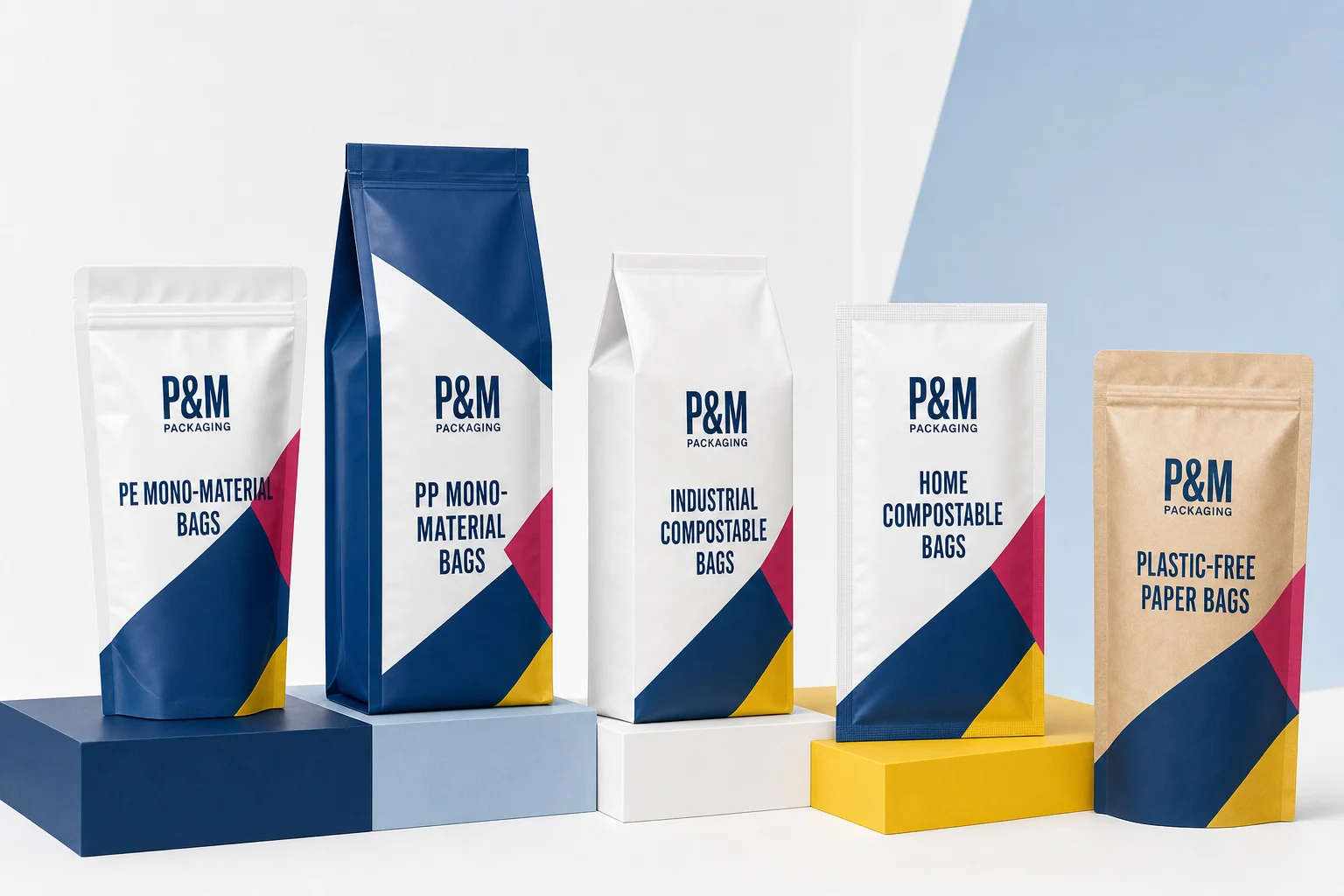
Industrial compostable pouches, home compostable bags, and plastic-free paper bags are different packaging pathways. Industrial compostable packaging requires evidence for managed commercial composting conditions; home compostable packaging requires separate evidence for lower-temperature household conditions; and plastic-free paper packaging must substantiate what materials, coatings, adhesives, sealants, windows, and closures are excluded. None of these terms automatically proves product protection, food-contact suitability, local acceptance, or another environmental claim.
Four terms that should not be used interchangeably
Industrial or commercial compostable packaging is designed and assessed for controlled composting facilities. Home compostable packaging follows a separate pathway intended for the lower and more variable conditions of a household compost system. Biodegradable describes breakdown only when the environment and timeframe are defined; it is not, by itself, a disposal instruction.
Plastic-free paper packaging follows a material-content claim rather than a composting claim. A paper bag may still use a polymer coating, heat-seal layer, adhesive, wet-strength chemistry, window, label, zipper, valve, or ink system. Natural kraft appearance does not prove that a package is plastic-free, compostable, recyclable, or biodegradable.
- Industrial or commercial compostable
- Home compostable
- Biodegradable under defined conditions
- Plastic-free paper
What is an industrial compostable pouch?
An industrial compostable pouch is designed for managed composting conditions with controlled temperature, moisture, aeration, and processing time. Certification or test evidence must match the exact item and applicable standard or program, including the relevant films, inks, adhesives, closures, labels, and other components.
Commercial compostability does not mean that every local organics program accepts the package. Facilities may limit compostable plastics or packaging because of sorting, contamination, processing time, organic-program requirements, or local policy. Consumer instructions should state the intended route and account for actual access where the package is sold.
How is home compostable packaging different?
Home compost piles generally operate at lower and less consistent temperatures than industrial facilities. A result or certification for commercial compostability should not be generalized to home composting; the complete package needs evidence applicable to the home-compost pathway and the claim shown on the artwork.
Home compostable also does not mean suitable for littering, soil disposal, marine conditions, landfill, or every backyard system. Instructions should identify the intended conditions and any preparation, time, climate, or component limitations supported by the evidence.
What makes a paper bag genuinely plastic-free?
Begin with a complete bill of materials and a written definition of plastic-free for the intended market. Review the paper substrate, barrier and heat-seal coatings, laminating or seam adhesive, grease treatment, wet-strength chemistry, inks, varnish, window, zipper, valve, spout, handle, label, tape, and release liner.
Paper-oriented structures may use water-dispersible, mineral, wax, cellulose, or other functional systems, but a material name alone does not prove that the final package contains no plastic. The supplier's declarations, analytical or certification evidence where applicable, manufacturing controls, and artwork language must refer to the same finished construction.
- Paper and fiber source
- Barrier and heat-seal coating
- Side-seam and lamination adhesive
- Ink, varnish, and surface treatment
- Window, closure, valve, fitment, and label
- Definition, evidence, scope, and intended market
Compare barrier, sealing, and shelf-life performance
A sustainable pathway still has to protect the product. Define oxygen, moisture, aroma, oil and grease, light, puncture, stiffness, seal integrity, seal contamination, filling temperature, storage, distribution, and shelf-life targets before selecting a material.
Compostable films and paper-based structures can have different moisture sensitivity, heat-seal windows, tear behavior, flex resistance, machinability, and barrier limits from conventional laminates. Test the actual product and final converted bag rather than assuming that a certificate also proves filling-line or shelf-life performance.
Closures and accessories can change the claim
A pouch body, zipper, valve, spout, cap, tin tie, window, label, and adhesive form one package. A certified film cannot support a finished-package claim if added components fall outside the evidence or certification scope.
For coffee bags, one-way degassing valves and reclosures require special attention. For stand-up pouches, the zipper, bottom gusset, sealant, tear feature, and label must remain compatible with the chosen material and end-of-life pathway. If a component is intentionally removed before disposal, the instructions and real consumer behavior should be considered.
How should compostable and biodegradable claims be written?
The U.S. Federal Trade Commission advises that compostable claims be supported by competent and reliable scientific evidence for all materials in the product or package. A claim should be qualified when the item cannot be composted safely or in a timely way at home, and commercial-composting claims should disclose limited facility availability where appropriate.
The FTC also cautions against unqualified degradable or biodegradable claims for items ordinarily sent to landfill, incineration, or recycling. Avoid broad claims such as green or eco-friendly unless the specific benefit and its significance can be substantiated clearly and prominently.
Account for California and other state requirements
California law establishes specific conditions for products and packaging labeled compostable or home compostable and restricts biodegradable, degradable, and decomposable labeling. Requirements may address applicable standards or certification, product identification, organic-program conditions, chemical restrictions, and supporting records.
State laws, certification schemes, standards, and facility acceptance can change. Before artwork approval, confirm where the package will be sold, which claim and mark will appear, whether mark authorization is required, what the evidence covers, its validity period, and the consumer disposal language.
RFQ checklist for compostable or plastic-free bags
A useful request starts with product protection and then defines the intended claim. Ask suppliers to identify exactly which structure and components their evidence covers rather than accepting a generic material certificate.
Provide the product and relevant chemistry, filling method, bag format and dimensions, fill weight, barrier and shelf-life targets, storage and distribution conditions, closure or valve needs, print and finish, quantity by artwork, intended sales markets, proposed claim and certification mark, disposal route, testing responsibilities, delivery timing, and any current reference package.
- Product, filling, storage, and shelf-life target
- Industrial compostable, home compostable, or plastic-free paper pathway
- Complete structure and every component
- Applicable standard, certificate, test, and authorized mark
- Sales geography and local disposal route
- Exact artwork claim and consumer instruction
- Performance and filled-package validation plan
General educational information only. Materials, performance, compliance, claims, quantities, and timing require confirmation for the exact packaging project.