Representative packaging solution
A Large-Format High-Barrier Bag for a U.S. Pet Food Brand
Large pet-food bags must protect aroma and fats while surviving product edges, filling, lifting, drops, compression, pallet movement, storage, and repeated consumer use. Material strength alone does not solve the complete pack.
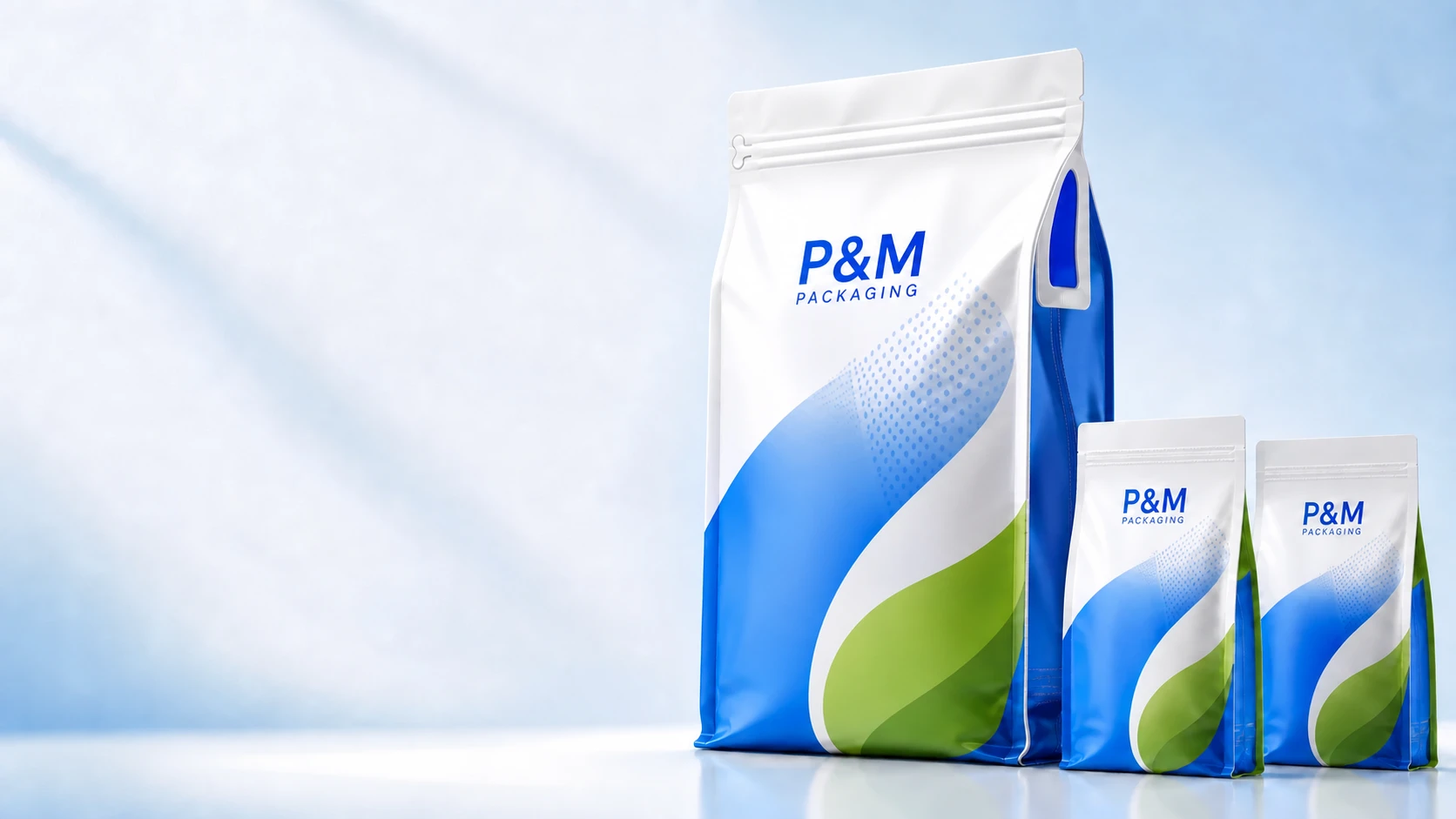
Representative packaging solution—not a customer case study. It illustrates a realistic project path without identifying or inventing a customer, order, testimonial, or performance result.
Direct answer
A large pet-food bag should be specified from fill weight, product shape and edges, fat or oil content, oxygen and moisture targets, bag geometry, opening and reclosure, filling, seal contamination, lifting, case or pallet handling, drops, compression, shelf life, and distribution.
The project problem
Start with the risk, not the decoration.
Dry pet food and treats can contain oils, aromas, dust and hard edges. Larger weights increase seal, drop, carry, flex-crack, compression, pallet and consumer-handling demands. A structure that performs in a small pouch may not be suitable at a larger format.
Review the complete solution, specification, and evidence plan Technical detail
Coordinated solution
One project path, with separate technical approvals.
Characterize the product and load
Record fill weight, bulk density, particle size and sharpness, oils, aroma, sensitivity, headspace, storage, shelf life, consumer use, and distribution hazards.
Select the format around handling
Compare flat-bottom, quad-seal, side-gusset and other bag geometries using filling, opening, reclosure, carrying, shelf or pallet presentation, dimensions and seal loads.
Engineer the full laminate
Balance oxygen and moisture barrier, grease resistance, toughness, puncture, flex-crack, stiffness, print surface, sealant, total thickness, zipper or closure, and applicable material evidence.
Validate the filled system
Test representative filled bags through seals, drops, compression, handling, abrasion, puncture, storage and distribution conditions appropriate to the project.
Specification direction
What can be proposed—and what still requires confirmation.
ComponentWorking directionConfirm before production
FormatFlat-bottom, quad-seal or side-gussetFill weight, opening, stability, filling, carrying and palletization
StructureHigh-barrier, grease-resistant, tough laminateProduct, shelf life, oxygen, moisture, aroma, puncture and flex
ClosurePress-to-close, slider or other reclosureOpening size, particles, repeated use, seal area and consumer handling
Large-format detailsReinforced seals and optional handle pathwayLoad, drop, lift, handle geometry, attachment and test protocol
Evidence plan
Validation before a performance claim.
Testing depends on the final product, package, process, market, and risk. This list is a project-planning baseline, not a certification statement.
- Filled-bag drop and handling evaluation
- Top, bottom and side-seal integrity
- Puncture and abrasion review
- Compression, pallet and distribution testing
- Barrier and shelf-life validation as required
- Zipper, handle and repeated-use testing
What this scenario demonstrates
High barrier and puncture resistance are performance requirements to validate on a filled large bag—not visual properties that a product image can prove.
Frequently asked questions
What material is best for large pet-food bags?
There is no universal best structure. Fill weight, product edges, oils, aroma, barrier, shelf life, printing, stiffness, closure, filling, drops, palletization, distribution, and end-of-life objectives determine the structure.
How is puncture resistance confirmed?
Use material data and project-specific testing on representative filled bags. Review product-edge puncture, drops, abrasion, flexing, seals, transport and storage rather than relying on thickness alone.
Can large pet-food bags use a zipper and carry handle?
Possible options depend on the format, opening, load, particles, reinforcement, filling, sealing, handling and test results. The complete package should be validated.